
In early 2024, Google and Yahoo rewrote the rules for sending email at scale. By 2026 those rules are the baseline, enforced strictly, and Microsoft has joined them. If you send in volume, here is exactly what mailbox providers now expect, and how to stay in the inbox.
What changed, and why
In October 2023, Google and Yahoo jointly announced new requirements for bulk senders, which took effect in February 2024. The aim was simple: cut the spam and spoofing that reach inboxes by holding high-volume senders to standards casual senders rarely think about.
Through 2024 and 2025 the enforcement only tightened, moving from quietly routing offenders to the spam folder toward outright rejection. In 2025, Microsoft announced equivalent requirements for high-volume senders to Outlook.com and Hotmail. The takeaway for 2026 is that authentication, an easy way to unsubscribe, and a low complaint rate are no longer best practices. They are the price of admission. And note these rules decide whether you reach Gmail at all; landing in the primary inbox rather than the Promotions tab is a separate battle, covered in how to escape Gmail's Promotions tab.
Authenticate everything: SPF, DKIM, and DMARC
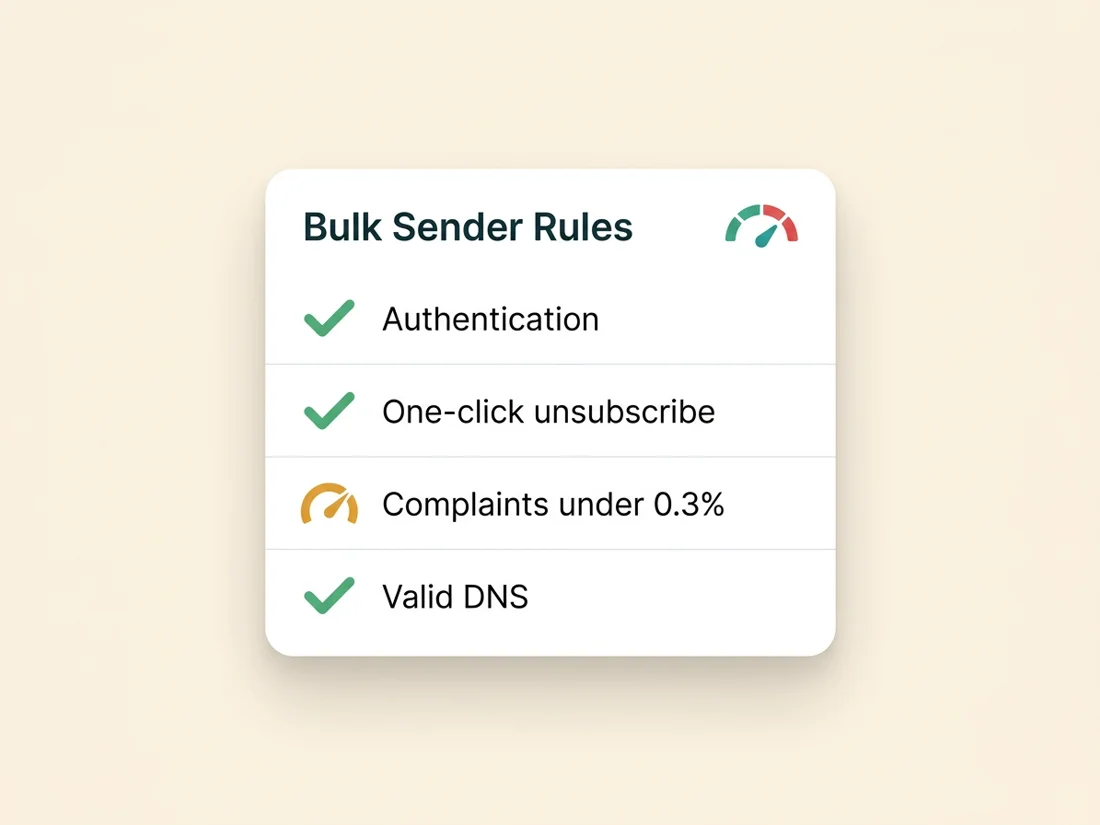
Bulk senders must authenticate their mail with both SPF and DKIM, and publish a DMARC record. A DMARC policy of p=none satisfies the baseline, though moving to quarantine or reject protects you far better. DMARC also requires alignment: the domain that passes SPF or DKIM has to match the domain your recipients actually see in the From field.
If any of those terms are unfamiliar, start with our complete guide to email authentication, which walks through each record in plain language.
One-click unsubscribe (and honoring it fast)
Marketing and promotional mail must offer one-click unsubscribe. Technically that means the List-Unsubscribe and List-Unsubscribe-Post headers defined in RFC 8058, so the recipient can opt out without leaving their inbox. You then have to process those opt-outs within two days. A visible unsubscribe link in the message body is still expected on top of the header.
Keep your spam complaint rate low
Google asks senders to keep their spam complaint rate, as measured in Google Postmaster Tools, below 0.3%, and ideally under 0.1%. Cross 0.3% and your delivery degrades quickly, often suddenly. Content plays a supporting role here: filters weigh reputation and engagement far above vocabulary, but mail written in spam's dialect starts with a handicap, and the honest breakdown of what still matters is in our spam trigger words reference.
The biggest lever you control here is list hygiene. Invalid addresses bounce, spam traps poison your reputation, and contacts who never open are the ones most likely to mark you as spam. Verifying your list and pruning the unengaged is the most reliable way to keep that complaint rate down. See how to clean your email list the right way for the full process.
- Remove invalid and mistyped addresses before they bounce.
- Drop known spam traps and disposable addresses.
- Re-engage or sunset contacts who have not opened in months.
Who counts as a bulk sender
For Google, a bulk sender is roughly anyone sending 5,000 or more messages a day to Gmail accounts, counted by sending domain. Once you cross that threshold, you are treated as a bulk sender going forward. Yahoo uses a similar bar, and Microsoft's rules target the same high-volume tier.
Even if you sit comfortably under the threshold, meeting these standards only helps your deliverability, so there is little reason to wait. Cold outreach senders should treat them as mandatory regardless of volume; our cold email compliance guide maps every provider rule to the outbound workflow.
How to get ready
If you do nothing else this quarter, work through this short list:
- Authenticate with SPF and DKIM, and publish a DMARC record.
- Add one-click unsubscribe and process opt-outs within two days.
- Watch your complaint rate in Postmaster Tools and keep it under 0.3%.
- Verify your list and remove unengaged contacts to protect that rate.
- Make sure your sending IPs have valid forward and reverse DNS and use TLS.
Protect your complaint rate
Verify your list and monitor your domain's authentication and reputation, all from one place.
Get started free