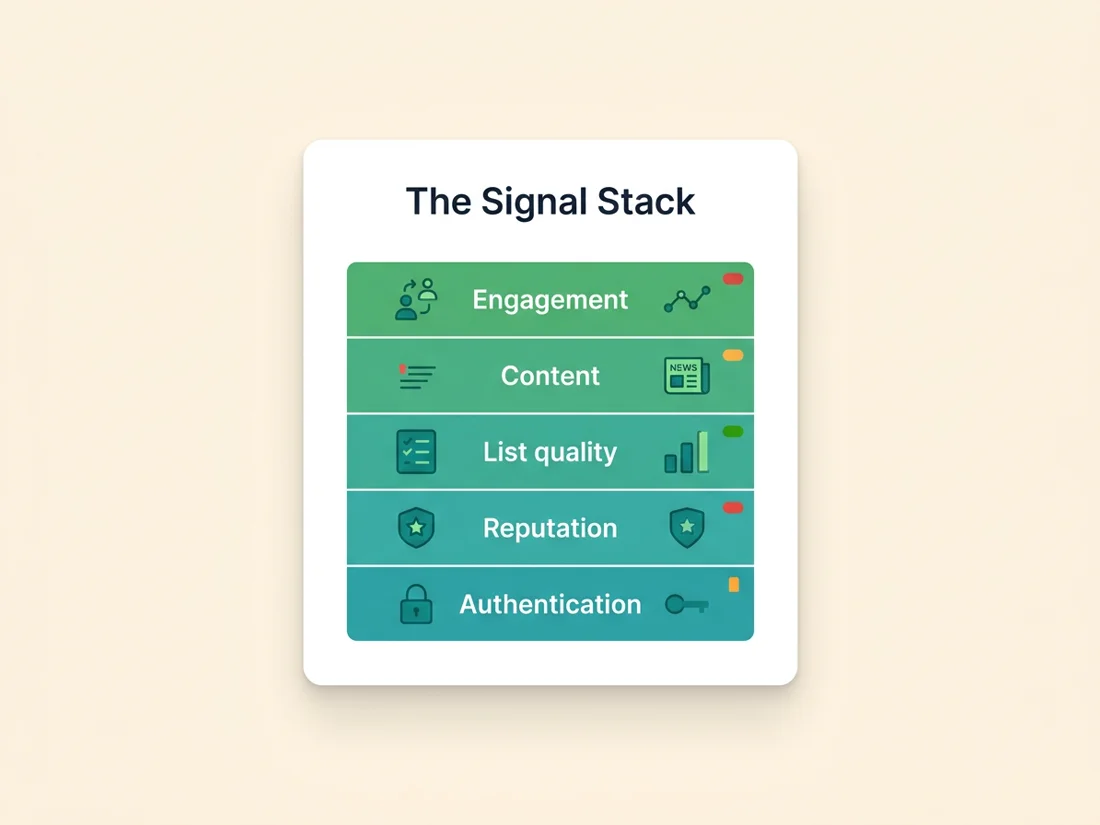
If your cold emails are landing in spam, it is almost never one single cause. Mailbox providers score every message against a stack of signals at once, and a cold campaign usually trips several of them together. The fix is not a trick or a magic subject line. It is a checklist you work through in order: authenticate the domain, warm it up, verify the list, spread volume across mailboxes, clean up the content, and then measure where your mail actually lands. Do those in sequence and spam placement collapses. Skip a step and you keep guessing.
Why cold email lands in spam
There are six common reasons cold email ends up in the spam folder, and most struggling campaigns are guilty of more than one.
- Authentication gaps. Missing or misaligned SPF, DKIM, and DMARC records tell Gmail and Outlook they cannot confirm you are who you claim to be. Unauthenticated mail is filtered aggressively or rejected outright.
- A cold domain with no warm-up. A brand new sending domain has zero reputation. To a filter, no history looks closer to suspicious than to neutral, so early volume gets held back.
- An unverified list with bounces and spam traps. Sending to dead addresses produces hard bounces, and old lists are riddled with spam traps that exist purely to catch senders who do not clean their data. If your delivered count itself is sliding, work through how to fix your cold email delivery rate alongside this guide.
- Spammy content. Heavy image-to-text ratios, link shorteners, too many links, trigger phrases, and mismatched display names all push your spam score up.
- Volume spikes. Going from a handful of sends to hundreds overnight on the same mailbox looks like a machine that just woke up. Sudden ramps are a classic filter trigger.
- Low engagement. If recipients never open, reply, or move you to the inbox, and instead delete or mark you as spam, providers learn that people do not want your mail and route it accordingly.
The good news is that every one of these has a concrete fix, and they build on each other. Here is the order that works.
Fix authentication first
Authentication is the entry ticket, so start here. Three records do the work. SPF lists the servers allowed to send for your domain. DKIM cryptographically signs each message so the receiver can verify it was not tampered with. DMARC ties the two together, tells providers what to do when a message fails, and aligns the visible From address with the authenticated domain. Set all three on every sending domain and make sure DMARC alignment passes on the address your recipients actually see.
Getting these wrong is the single most common reason cold email is rejected before it even reaches a filter. Publish the records, then confirm they resolve and align rather than assuming they do. SpamCipher's domain health and DMARC monitoring watch this continuously, so if a record breaks or drifts you find out before a campaign suffers for it. Authentication alone will not put you in the inbox, but without it nothing else you do matters.
Warm the domain and mailboxes
A new domain and a new mailbox have no reputation, and pointing real campaign volume at them is how you get filtered on day one. Warm-up earns each identity a reputation before you ask it to carry weight. It means a gradual ramp of genuine, engaged activity: low starting volume, messages that get opened and replied to, and a steady daily increase over two to four weeks.
Done properly this teaches Gmail and Outlook that the mailbox belongs to a real person who sends mail people want. SpamCipher runs warm-up on its own seed network, so the positive engagement your new mailboxes need is real, measured activity rather than a black box. Only once an identity is consistently warm should it join your active sending pool. If you are standing up fresh domains, warm every one of them before it sends a single cold message.
Verify the list
List quality is where a lot of otherwise careful senders quietly torch their reputation. Every hard bounce is a signal to the providers that you do not know who you are mailing, and old lists are full of dead addresses and spam traps. Cross a bounce rate of around 2% and Gmail, Outlook, and Yahoo stop giving you the benefit of the doubt.
The fix is to verify the list before you send, not after. Run every address through validation to remove invalid mailboxes, catch-all risks, and known trap patterns, so bounces stay near zero. This is the cheapest, fastest reputation win available, and it protects the warm-up work you just did. Verification is a core part of SpamCipher precisely because it sits upstream of everything else: a clean list keeps bounces low, which keeps reputation high, which keeps you in the inbox.
Spread volume and clean the content
With authentication, warm-up, and a verified list in place, the next lever is how you send. Do not pile volume onto one or two mailboxes. Spread it across several warmed mailboxes and let the platform rotate sending so no single identity spikes. SpamCipher supports unlimited sending with inbox rotation for exactly this reason: the pool carries the volume while every individual mailbox stays inside a safe daily pace.
Then clean up the message itself. Keep a healthy text-to-image ratio, avoid link shorteners and excessive links, drop the obvious trigger phrases, and make the From name and address consistent and honest. Personalise so the mail reads like a message to one person, because engagement is a ranking signal and relevant mail gets more replies. Content will not save a campaign with broken auth and a dirty list, but once the fundamentals are right, clean content is what lifts you from delivered to genuinely wanted. And if the rebuild is more than your team can take on, our guide to choosing a cold email agency covers how to vet outside help without handing over your domain reputation.
Measure real inbox placement
You cannot fix what you cannot see, and open rate will lie to you. Apple Mail Privacy Protection and similar features pre-fetch images, so a healthy-looking open rate can sit on top of mail that is quietly landing in spam. The only honest measure is inbox placement: the share of your mail that reaches the primary inbox rather than spam or a promotions tab.
You get that number with seed-based testing. Send your real campaign to a private network of seed accounts across Gmail, Outlook, and Yahoo and observe exactly where each copy lands, per provider. No sampling, no privacy-blurred pixel. That tells you the truth: are you in spam or not, and with which provider. SpamCipher runs this whole loop in one platform, from verification and warm-up through unlimited sending with inbox rotation to seed-based placement testing and ongoing domain, DMARC, and blacklist monitoring. Fix the stack in order, then watch the placement number climb and stay there.
Stop landing in spam
Verify your list, warm your domains on a real seed network, send unlimited with inbox rotation, and measure true inbox placement, all on one platform with SpamCipher ONE.
Fix your inbox placement