
Almost every team that tries to scale cold email does it the way that guarantees a crash: they pour more and more volume through too few domains, complaints creep up, and the whole sending reputation collapses at once. There is a safe way to grow, and it is not subtle: spread volume across many warmed secondary domains and mailboxes, keep every mailbox inside safe limits, verify lists before you send, and let automatic throttling pause anything that crosses a complaint or bounce threshold before it drags the pool down. That is exactly what SpamCipher is built to do. We are the cold email platform for unlimited, fully automated cold email, and we are the only platform that can promise you 90%+ inbox placement. This guide is how you get to real scale without torching the domain reputation you depend on.
Why teams that scale cold email crash their reputation
The failure pattern is so consistent it is almost boring. A campaign works at low volume, so the obvious move looks like turning the same dial up: same domain, same one or two mailboxes, three times the send. That instinct is what torches domains. Reputation at the mailbox providers is scored per sending identity, and it is not linear. A mailbox sending 40 clean, engaged messages a day looks like a person. The same mailbox suddenly pushing 400 looks like a machine that just woke up, and the filters treat it accordingly.
The moment volume outruns reputation, three things move at once. Complaints tick up because you are reaching more marginal recipients, bounces rise because a bigger list has more dead addresses, and engagement per message falls because you are casting wider. Each of those is a signal the providers weight heavily, and they compound. Cross a spam-complaint rate of 0.3% or a bounce rate of 2% and Gmail, Outlook, and Yahoo stop giving you the benefit of the doubt. What makes it brutal is the blast radius: when a shared primary domain goes down, every mailbox on it goes down with it, and domain reputation recovers slowly if at all.
So the real problem with scaling cold email is not volume itself. It is concentration. Piling volume onto too few identities is what converts growth into a reputation crisis. Fix the concentration and the ceiling disappears.
How to scale cold email horizontally, not vertically
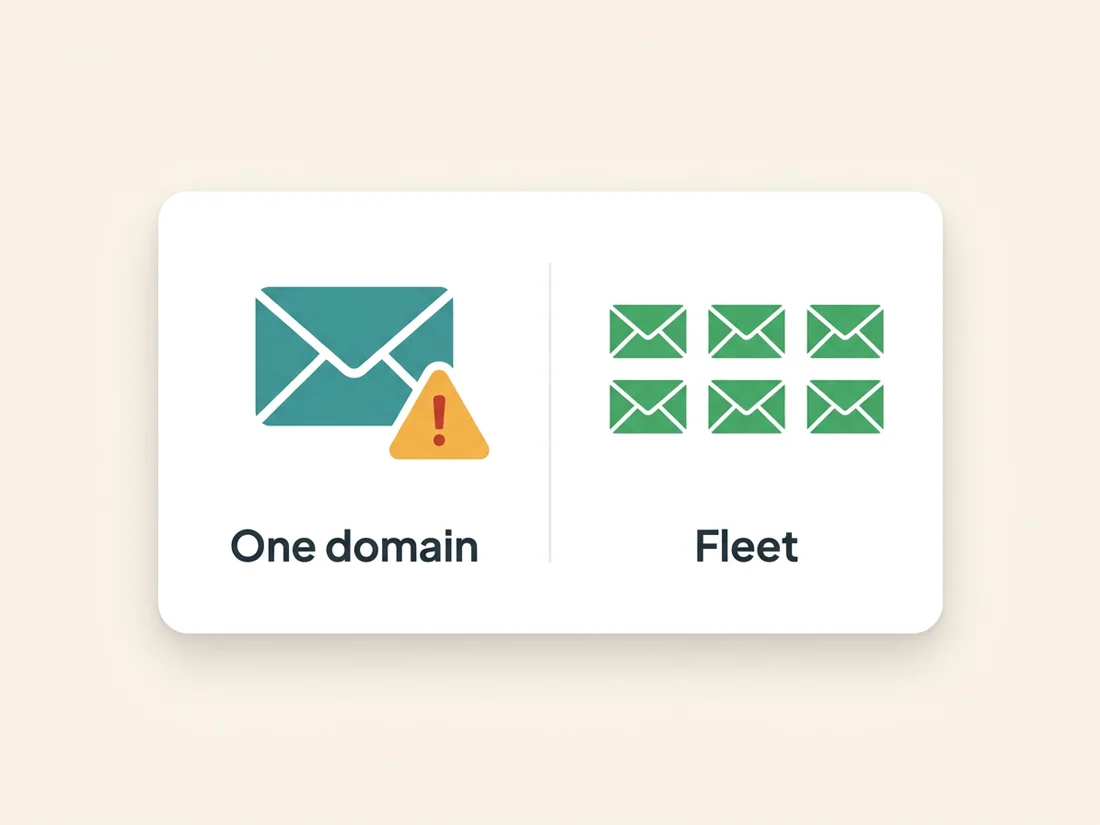
The single most important shift is direction. Vertical scaling means pushing more volume through the same mailbox until it breaks. Horizontal scaling means adding more sending identities and keeping each one modest. Every team that sustains real cold email at scale does the second thing, and it starts with never touching the domain your business actually runs on.
Your primary brand domain is not a sending asset, it is a liability you cannot afford to lose. If it lands on a blocklist because a cold campaign misfired, your real business mail, invoices, support, sales replies, goes to spam too. So cold email at scale runs entirely on secondary domains: lookalike variants registered specifically for outreach, each with its own authentication and its own reputation to spend. The math of multi-domain sending is simple. If a safe per-mailbox pace is a few dozen sends a day, and you run a handful of mailboxes per domain across a set of domains, your total capacity grows without any single identity ever leaving its safe lane.
- Never send from your primary domain. Register secondary domains for outreach and keep brand mail completely separate. This one rule prevents the worst outcome, a blocklisting that takes down your real business.
- Spread mailboxes across domains. A few mailboxes per domain, a set of domains in the pool. The pool carries the volume; no individual mailbox is ever pushed hard.
- Authenticate every domain fully. SPF, DKIM, and DMARC on each sending domain, aligned on the visible From. If authentication is not second nature yet, our BYO vs done-for-you infrastructure guide walks through both ways to stand this up.
- Rotate sending across the pool. Let the platform distribute each campaign across the fleet so load is even and no mailbox spikes.
This is the whole idea behind owning your cold email pipeline: capacity is a property of the fleet, not of any one mailbox. Want more volume? Add more warmed domains and mailboxes. You scale cold email by widening the base, never by leaning harder on what you already have.
Warm everything before you scale it
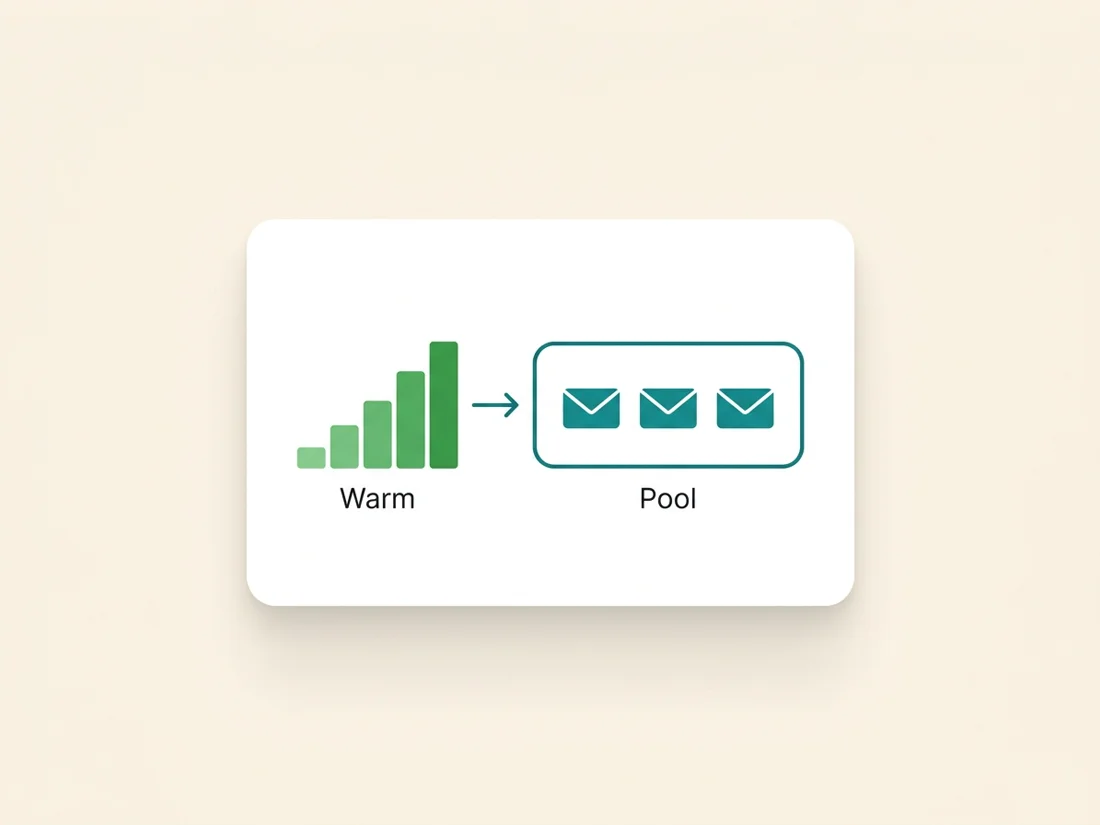
A new domain and a new mailbox have no reputation at all, which to a filter is closer to suspicious than to neutral. Point real campaign volume at a cold identity and you do not scale, you incinerate. Warm-up is the non-negotiable step that earns each identity a reputation before you ask it to carry weight.
Warming means a gradual ramp of genuine, engaged-looking activity: low initial volume, conversations that get opened and replied to, a steady daily increase over two to four weeks. Done right, it teaches Gmail and Outlook that this mailbox belongs to a real person who sends mail people want. Only after an identity is consistently warm does it join the active sending pool. The discipline that matters at scale is that this is continuous, not a one-time event, because you are always adding new domains to widen capacity, and every one of them has to be warmed before it sends a single cold message. Our deep dive on warming up new domains covers the ramp schedule in detail.
The trap to avoid is warming a handful of identities, scaling them, and then bolting on new cold domains under deadline pressure without warming them first. That is how a fleet that looked healthy suddenly starts leaking into spam. At scale, warm-up has to be a standing part of the machine: new identity registered, authenticated, warmed, then and only then promoted into rotation.
The throttle that saves your reputation
Here is the part that separates a platform that can promise placement from a sender that just hopes for the best. Even with a warmed, well-spread fleet, one mailbox will occasionally go wrong: a bad batch of addresses, a subject line that draws complaints, a domain that catches a reputation dip. At scale you cannot watch this by hand, and by the time a human notices, the damage has already propagated. The defense has to be automatic.
SpamCipher runs a per-mailbox abuse monitor that watches the two signals that actually predict a reputation collapse: bounce rate per mailbox and complaint plus unsubscribe rate per sending account, measured over a rolling window with a minimum-volume floor so a single stray event does not trip it. When a mailbox drifts toward the danger zone, the response is graduated, not binary. First it throttles, cutting that mailbox's send rate. If the signal keeps degrading, it pauses the mailbox entirely. In the worst case it suspends, holding sending until the problem is resolved. Recovery is automatic once the metrics return to safe ranges, with hysteresis so a mailbox does not flap on and off at the boundary.
The thresholds are the real ones the providers enforce: keep spam complaints under 0.3% and bounces under 2%, and the guardrail acts before you cross them, not after. That is the crucial difference. A monitor that alerts you after a domain is already burned is a postmortem. A monitor that throttles a drifting mailbox inside a single monitoring cycle, before it drags the pool down, is what lets you run unlimited volume and still hold the number. One bad mailbox gets quarantined; the other ninety-nine keep sending clean. That containment is why concentration is dangerous and a defended fleet is not.
Measure placement as you scale
You cannot protect a number you never measure, and open rates are not that number. Apple Mail Privacy Protection and its imitators pre-fetch images, so a healthy-looking open rate can sit on top of a campaign that is quietly landing in spam. The only honest measure of whether your growing fleet is actually reaching humans is inbox placement: the share of mail that lands in the primary inbox rather than the spam folder or a promotions tab.
The way you get that number truthfully is seed-based measurement. You send your real campaign to a private network of seed accounts across Gmail, Outlook, and Yahoo and observe exactly where each copy lands, per provider, per domain. No sampling, no inference, no privacy-blurred pixel. At scale this becomes a per-domain health signal: if one secondary domain in your pool starts slipping while the rest stay green, seed testing surfaces it early, and you can pull that domain for a re-warm before it costs you replies. This is the ground truth every other metric depends on, and it is why we can make a promise no bolt-on stack can. We break down the full system in how to own the inbox at 90%+.
- Test the real campaign, not a sample. Seed the actual message and cadence you are about to scale, so the number reflects reality.
- Watch placement per domain. A pool is only as healthy as its weakest domain; per-domain seed data catches a slip before it spreads.
- Treat 90%+ as the standard. Aim for 90%+ across major providers, 80% as the floor, and anything below 70% as a reputation problem to fix now, not a slump to wait out.

Unlimited email sending, done safely
Put the pieces together and the phrase "unlimited email sending" stops being a marketing fantasy and becomes an engineering result. There is no magic mailbox that safely sends infinite volume. What there is, is horizontal scale: many warmed secondary domains, a modest and safe pace on every mailbox, verified lists so bounces stay near zero, seed-based placement telling you the truth per domain, and an automatic throttle that quarantines any identity that drifts before it can hurt the rest. Unlimited is what that architecture adds up to. You raise the ceiling by widening the base, and the guardrails make the base safe to widen.
This is precisely why an owned pipeline beats a stitched stack of point tools. When one system owns verification, warm-up, sending, placement measurement, and reputation defense, the throttle can act on the same data the placement test produces, and a slipping domain triggers a re-warm without a human in the loop. Duct-tape a sender to a separate warm-up service to a separate verifier and the seams are exactly where the damage hides. SpamCipher is that pipeline in one product, which is the only reason we can stand behind a real placement promise. We are the cold email platform for unlimited, fully automated cold email, and we are the only platform that can promise you 90%+ inbox placement, measured with real seeds, warmed on our own network, and protected automatically. That is how you scale cold email to true volume without ever torching the domain reputation your business runs on.
Scale cold email without the crash
Send unlimited, fully automated cold email across a warmed fleet and still land 90%+ in the inbox, with automatic per-mailbox throttling protecting your reputation the whole way up. One platform, the whole pipeline.
Start scaling cold email safely