
Most product launches get one email: the announcement, sent to everyone, on launch day, and then silence. It underperforms every time, because a single message asks a cold-start audience to absorb the problem, the solution, the proof, and the decision in one read. A product launch email sequence spreads that work across six emails and two weeks, so by launch day your audience already wants the thing you are finally letting them buy. This guide gives you the full playbook: the six emails with exact timing, the variants for customers versus subscribers versus cold prospects, the per-email writing rules, and the deliverability trap that quietly ruins launch weeks, because a launch is a volume spike and volume spikes are exactly what spam filters are trained to distrust. We are SpamCipher, AI sales engagement, lead intelligence, deliverability and email security in one platform, with unlimited sending on SpamCipher ONE (every mailbox kept inside its own daily cap) and inbox placement tests on our own seed mailboxes; launch week is when senders need that measurement most, so this is a playbook we run, not just write about.
Why launch emails fail: the announcement blast
The single-announcement launch fails for three reasons that compound into one bad day.
It asks for too much in one step. A purchase decision has stages: noticing the problem, believing a solution exists, trusting your version, and acting. The lone announcement compresses all four into one email, which means it converts only the sliver of your list that had already completed the first three stages on their own. Everyone else needed the earlier conversations, and nobody had them.
It lands on one day. Whatever share of your audience does not open email that particular day (traveling, buried, on holiday) misses the launch entirely, because there is no second touch. A sequence gives every subscriber several chances to catch the story at whatever point they tune in.
It teaches the filters nothing good. From the mailbox provider's side, the blast looks like this: a sender who normally mails a modest weekly volume suddenly fires their entire list in one hour, to every stale address included, with a promotional subject. Bounce and complaint signals arrive in one concentrated burst, and the filters respond the way they respond to any anomaly: skeptically, on the exact day placement matters most. The sequence structure fixes the narrative problem; the sending discipline later in this guide fixes this one.
The alternative is not more hype, it is more structure: a short arc that does the noticing, believing, and trusting before the ask. That arc is a specialized cousin of the drip campaign, with one crucial difference: it runs on the calendar (everyone experiences launch day together) rather than on each contact's personal clock.
The six-email product launch email sequence
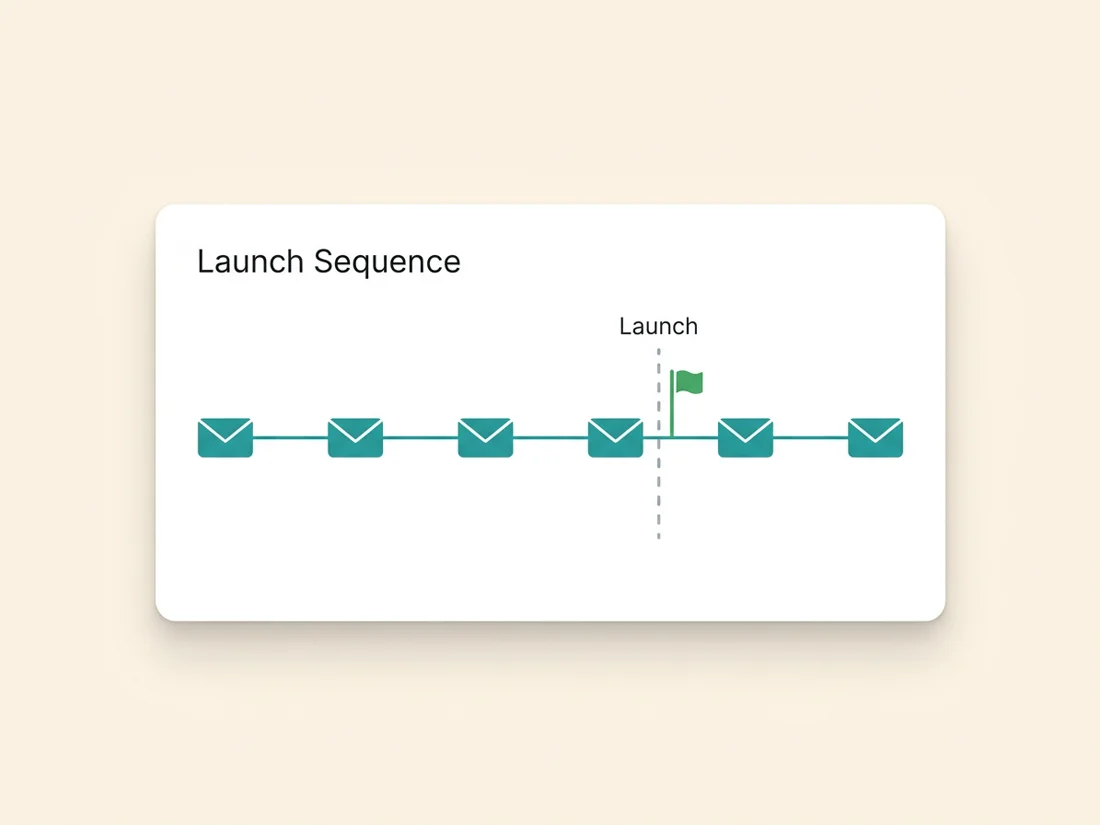
Six emails, spread across roughly fifteen days, each with one job. The timing flexes a few days either way; the order does not.
Email 1, the teaser (Day -10). Job: open a loop. One or two short paragraphs that name the change coming ("On the 24th we are shipping something that changes how you do X") without revealing the product. Include one concrete detail to make it real (a date, a screenshot fragment, a number) and, for high-intent audiences, an early-access or waitlist link, which doubles as your demand gauge. No price, no feature list. Curiosity is the entire payload.
Email 2, the problem (Day -7). Job: make the reader feel the cost of the status quo. Tell the problem story in their language: the workflow that eats an afternoon, the number that will not move, the workaround everyone tolerates. Do not mention the product beyond a closing line ("this is exactly what we have been building against; more next week"). This is the email that makes launch day feel like relief instead of interruption, and it is the one most teams skip because it feels like it sells nothing. It sells everything.
Email 3, the story and the how (Day -3). Job: show, credibly, that your solution works. Walk one concrete scenario end to end: here is the before, here is what the product does, here is the after, with real screenshots or numbers where you have them. This is also the right place for origin honesty ("we built this because we hit the problem ourselves") and for naming who it is NOT for, which buys more trust than any superlative. Close with the launch date and what will happen ("doors open Tuesday, this list gets first access and launch pricing").
Email 4, launch day (Day 0). Job: the ask, clean. Short. The product is live, here is what it does in one sentence, here is the price, here is the launch incentive if you have one, here is the button. Everything long-form was already said; launch day rewards clarity and punishes throat-clearing. Send it in the morning of your audience's primary timezone so the whole day works for you.
Email 5, the proof (Day +2). Job: convert the hesitant with evidence. By now you have first buyers and first reactions; use them. Early customer quotes, a mini case study, usage numbers ("400 teams activated in 48 hours"), answers to the three questions your support inbox actually received. Social proof lands hardest exactly here, on the people who opened everything and clicked nothing, because their objection was never interest, it was risk.
Email 6, the close (Day +5). Job: end the launch honestly. If there is a real deadline (launch pricing ends, bonus expires, cohort closes), say so plainly and once; a genuine deadline converts and a fake one corrodes trust you will want at the next launch. If there is no deadline, close the arc instead: recap what shipped, thank the list, and state what happens next. Either way, this email exists because sequences that trail off teach your audience that your emails do not require decisions.
Email is one channel of the launch. Flowjam's product launch announcement playbook lays out the full 14-day sequence across email, social and press.
One launch, three audiences
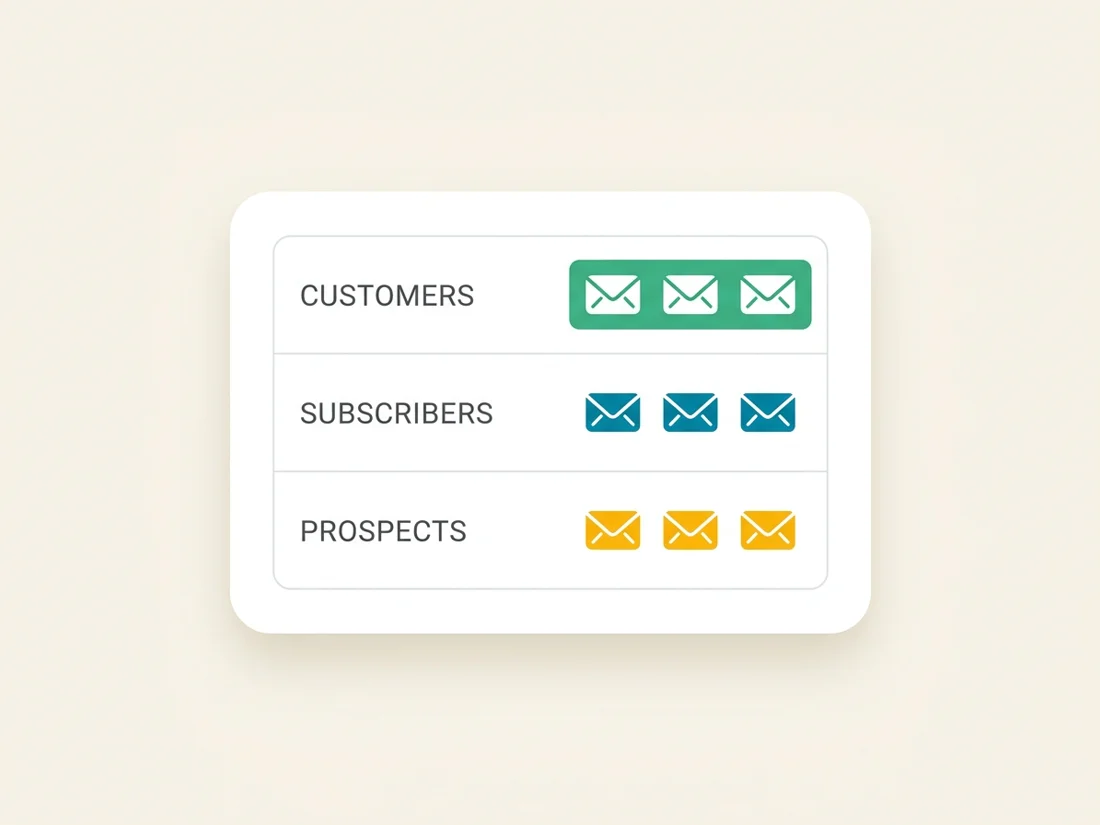
The same launch should read differently to the three audiences most senders hold, and the differences concentrate in the first email and the ask.
Existing customers get the warmest variant: the teaser can be more direct (they already trust you), the problem email should acknowledge what they already use ("you solved X with us; Y is the half we could not help with, until now"), and the launch-day ask should include their upgrade path and any loyalty pricing explicitly. Customers also produce your Email 5 proof, so invite replies and early access here first: a launch that starts inside the customer base arrives at the public with testimonials already in hand.
Subscribers who are not yet customers get the full arc exactly as written above. This is the audience the sequence was designed for: interested enough to be on the list, unconvinced enough to need the problem and proof emails.
Cold prospects are a different country with different laws. Do not pour the six-email marketing arc onto people who never opted in; that is how launch week becomes complaint week. Cold outreach around a launch follows outreach rules: plain text, two to three touches, the launch as the trigger event ("we just shipped X, and given your team does Y, it seemed worth one note"), one low-friction ask, instant exit on any reply, all per the sales email playbook, and sent from separate outbound domains so cold-audience risk never touches the house list's reputation. The launch gives cold email its best possible opener; it does not suspend any of its rules.
Writing rules per email
The arc carries the strategy; these rules keep each email worth opening.
- One job per email, stated in the first two lines. The teaser teases, the proof proves. The moment an email starts doing a second job, move that content to the email whose job it is.
- Subjects follow the arc, not the formula. Curiosity subjects for emails 1-2 ("something is changing on the 24th"), concrete subjects for 3-4 ("X is live: what it does and what it costs"), evidence subjects for 5-6 ("what 400 teams did with X in 48 hours"). The full craft is in the subject line guide; launch-specific rule: never use fake urgency early, because you will need real urgency to be believed at the close.
- Escalate design with intent. Emails 1-3 read best as plain, personal notes from a named founder or maker. Launch day can carry the one designed email of the sequence (product shot, button). Then return to plain for proof and close. The contrast itself signals that launch day is the event.
- Let readers opt out of the launch without leaving the list. One line in email 2 or 3 ("not interested in this one? click here and we will skip you for the rest of the launch") protects your unsubscribe rate and your relationship with the people who love you but do not need this product. Fewer annoyed readers on emails 4-6 also means fewer complaints exactly when complaint rate matters most.
- Write email 6 first. If you cannot state the deadline, the offer, and the closing argument now, the launch is not ready, and discovering that on Day -10 is a gift.
Your product launch email sequence is a volume spike in disguise
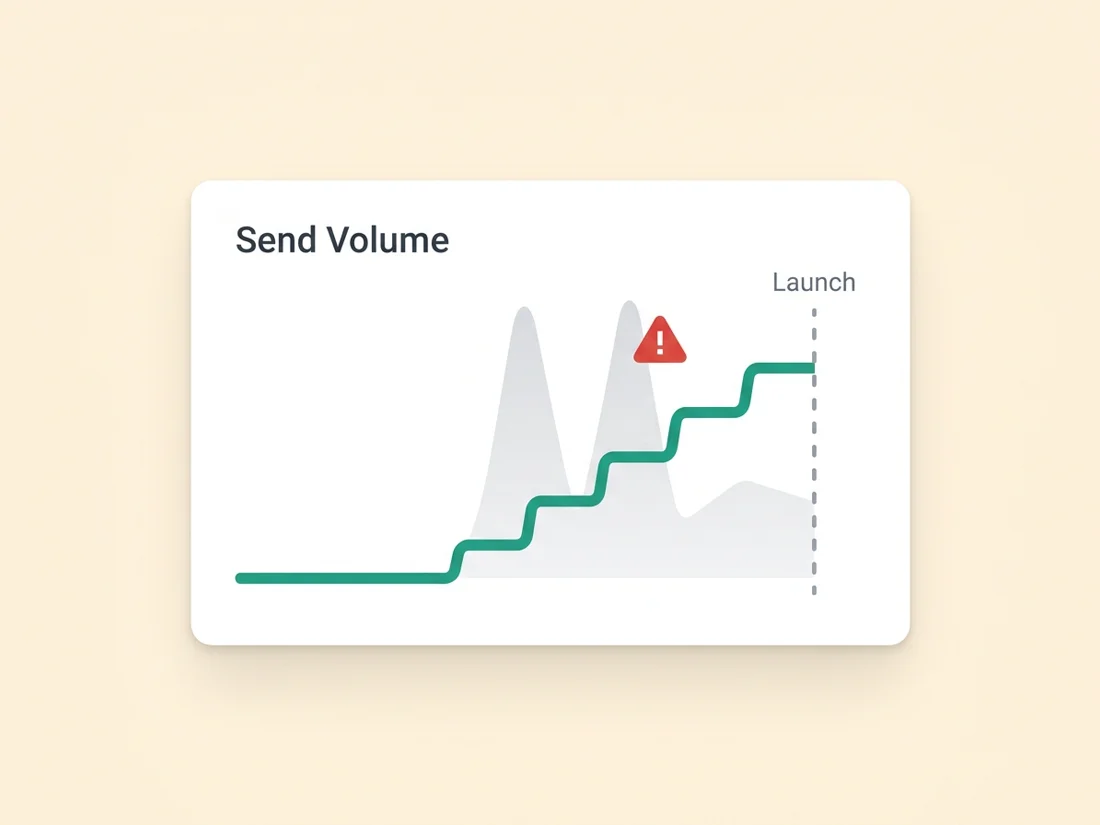
Here is the part launch checklists skip, and it decides whether the sequence above performs or silently disappears. To a mailbox provider, your launch looks like a behavioral anomaly: a sender with a stable baseline suddenly multiplying daily volume, mailing dormant segments, with promotional content and a click-heavy call to action. That fingerprint overlaps uncomfortably with what a compromised account looks like, and filters respond to anomalies with the spam folder first and questions never. The fix is to make launch week look, to the infrastructure, like a planned crescendo instead of an explosion.
- Validate the list weeks before, not the night before. The launch is precisely when teams mail everyone, including the segment untouched since last year, which is the segment carrying the decayed addresses and recycled traps. Run full validation two to three weeks out, apply remove/hold/keep, and re-permission or exclude the long-dormant rather than "including them just this once." One launch-day trap hit can quarantine the whole week.
- Ramp the volume in steps. The sequence structure helps naturally (emails 1-3 go to progressively engaged segments as you tune it), but plan it deliberately: if launch day means five times baseline volume, step your sends up across the preceding week and split launch day itself into staggered batches by segment and timezone rather than one buttonpress. Filters tolerate growth; they punish discontinuity.
- Warm anything new well ahead. A new sending domain or subdomain for the launch, or a new outbound domain for the cold variant, needs its two to four weeks of warm-up completed before Day -10, not started at it. Launch week is the worst possible week to be an unknown sender.
- Watch placement live, not opens. Seed accounts across Gmail, Outlook, and Yahoo tell you where email 1 actually landed while there is still time to fix emails 2 through 6. If the teaser hit Promotions or spam, you want that fact on Day -10, and open rates will not tell you; measured inbox placement will. Between sends, throttle on the signals: a bounce or complaint uptick after any email is the cue to slow, clean, and re-check before the next.
Measuring the launch
Judge the sequence the way you judge any sequence: by progression and by dollars, not by averages. The numbers worth a dashboard: revenue and conversions attributed to the sequence (the scoreboard), per-email click-through progression (a cliff at email 3 means the story email is not landing), waitlist or early-access signups from the teaser (your leading demand indicator, readable ten days before revenue), placement per send from seeds (the number that explains every other number), and unsubscribes plus complaints per email (the cost side, and the argument for the skip-this-launch link). Archive the numbers with notes while they are fresh: your next launch inherits this one's baselines, and launch sequences are rare enough that institutional memory is the difference between iterating and starting over.
Two patterns to read correctly. High opens with low launch-day conversion usually means the problem email underdelivered (interest without felt need), so strengthen email 2 next time rather than discounting harder on email 6. And strong early emails with a weak close usually means the deadline was not believed, which is the compounding cost of every fake-urgency email your audience has ever received from anyone; the only repair is being the sender whose deadlines are real.
Run the whole arc on the infrastructure it deserves and launch week becomes a compounding asset instead of an annual gamble: list validated at the gate, sequences with conditions and stop on reply, new mailboxes ramped up over 14 days and throttled or paused when signals turn, and placement tested on seed mailboxes before and during the send. That stack is SpamCipher, where validation, sequences, warm-up and placement tests share one platform, which is exactly what launch week leans on. The full architecture is in how to own the inbox; the six emails above are what you run on it.
Launch on a pipeline built for launch week
Validate the list, warm the domains, ramp the volume, and test real placement on seed mailboxes while the sequence runs. Unlimited sending on ONE (per-mailbox caps), with placement measured on the week you need it most.
Prepare your launch