
Your email list is decaying right now, whether you touch it or not. People change jobs, abandon old inboxes, and lose interest. Left alone, a list quietly fills with addresses that bounce, drag down your numbers, and put your sender reputation at risk. Cleaning it the right way is one of the highest-leverage things a marketer can do, and it is simpler than it sounds.
Why every email list goes stale
No list stays fresh on its own. ZeroBounce's Email List Decay Report put the 2025 decay rate at roughly 23%, and most estimates land in the same 20 to 30 percent per year range. In plain terms, if you do nothing, a meaningful slice of the contacts you collected this year will be dead weight by next year.
The reasons are mundane. Someone leaves a company and their work address is switched off. A personal inbox gets abandoned for a newer one. A typo at signup created an address that never existed in the first place. B2B lists tend to decay fastest, because a business address lives and dies with the person's employment. None of this is a failure on your part. It is just the natural half-life of contact data, and the only fix is regular maintenance. The compounding math behind that decay rate, and the prevent-and-clean system that manages it, is covered in depth in our email list decay guide.
What a dirty list actually costs you
A bloated list feels harmless because the bad addresses sit there silently. The cost shows up the moment you hit send.
- Hard bounces hurt your reputation. Every send to a dead address is a permanent failure that mailbox providers notice. Google treats a 2% bounce rate as a danger line, and a healthy target is below 1%.
- Spam traps poison your standing. Recycled and pristine traps are addresses anti-spam groups watch. Hitting them signals that you are not cleaning your list, and repeated hits can land your domain on a blocklist like Spamhaus.
- You pay to email nobody. Most platforms charge by contact or by send. Dead addresses inflate your bill for zero return.
- Your metrics lie to you. Open and click rates calculated against a list full of invalids understate real engagement, so you end up optimizing against noise.
- Disengaged contacts complain. People who no longer want your mail are the most likely to hit the spam button, which is the single fastest way to wreck deliverability.
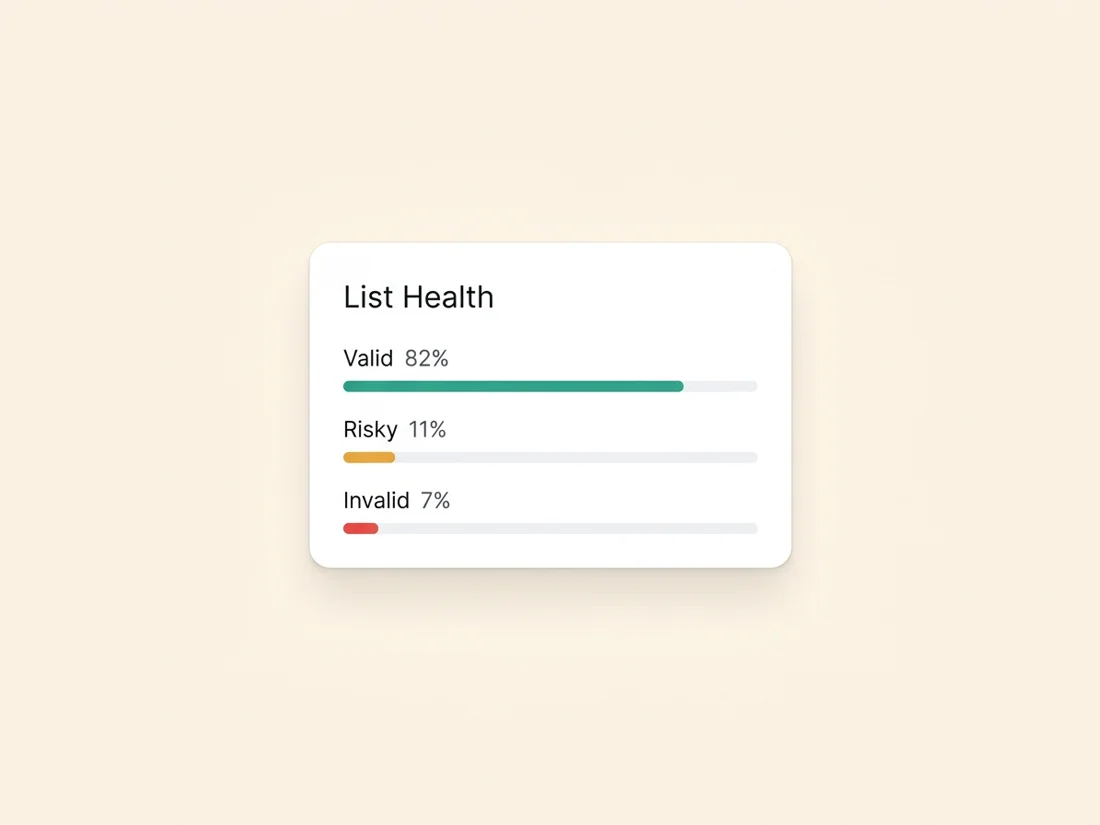
The address types verification surfaces
This is where it helps to be precise. Validation checks that an address is correctly formatted, the cheap syntax-level pass. Verification goes further and checks whether the mailbox actually exists and can receive mail; the full layered process is explained in what is email validation. A good verification run sorts your contacts into a handful of categories, and what you do next depends on which bucket they fall into.
- Valid. The mailbox exists and accepts mail. Safe to send.
- Invalid. The address is malformed or the mailbox does not exist. These are your hard bounces in waiting. Remove them.
- Accept-all (catch-all). The domain accepts mail to any address, so the server will not confirm whether this specific mailbox is real. Inherently uncertain; the full handling policy is in our catch-all email guide.
- Role-based. Shared addresses like info@, sales@, or support@ that belong to a function rather than a person. They correlate strongly with spam complaints.
- Disposable. Temporary, throwaway addresses created to get past a signup form. They have no lasting value.
- Spam trap. Addresses flagged as likely traps. Never mail these.
- Unknown. The receiving server was too slow or unresponsive to give a clear answer. Worth re-checking later.
How to clean your list, step by step
You do not have to do this by hand. The process is straightforward once you know which buckets to act on.
- Run a bulk verification pass. Upload your full list to a verification service and let it categorize every address. This is the foundation everything else builds on.
- Remove the hard-invalids. Anything flagged invalid, disposable, or as a spam trap should come off the list immediately. There is no upside to keeping them, and every send to them costs you.
- Hold the risky and accept-all addresses. Move catch-all and other risky results into a separate segment instead of deleting them outright. Send to this group cautiously, watch how they perform, and graduate the ones that engage.
- Decide on role-based addresses. If your audience is genuinely team inboxes, keep them. If you are doing one-to-one marketing, suppressing them lowers your complaint risk.
- Protect your engaged core. Before any bulk pruning, segment out your most active subscribers so a cleaning sweep never catches good contacts by accident.
How often you repeat this depends on volume. High-volume senders benefit from a monthly pass, mid-sized lists from a quarterly one, and smaller lists from a clean every six months or before any major campaign.
How to keep it clean going forward
Cleaning is not a one-time chore. The most efficient teams stop bad addresses from entering the list in the first place, so each cleanup is smaller than the last.
- Verify at the point of capture. Wire a real-time validation and verification API into your signup forms so typos and dead addresses are caught before they are ever stored. Even a basic form tool can be wired this way; see Google Forms email validation for a worked example.
- Use double opt-in. A confirmation email proves the address is real and the person actually wants to hear from you, which cuts bounces and complaints from day one.
- Re-verify dormant segments. Before a big send to contacts you have not emailed in months, run them through verification again. Addresses go stale in storage.
- Run a sunset policy. Define a clear inactivity window, try to win back quiet subscribers with a re-engagement sequence, and let go of those who never respond. Chronic non-openers are the ones most likely to mark you as spam.
How SpamCipher keeps your list healthy
SpamCipher is the cold email platform for unlimited, automated sending, and a clean list is the front gate of the owned pipeline behind its 90%+ inbox placement. It handles both halves of the job in one place. Upload a list for bulk verification and get every address sorted into valid, invalid, and risky buckets, so you know exactly what to remove, what to hold, and what to send with confidence.
For the prevention side, SpamCipher's real-time validation and verification API plugs into your signup flow and checks each address the moment it is entered, keeping the junk out before it ever reaches your database. Pair that with our guide to sender reputation and a clear understanding of hard versus soft bounces, and you have a list that stays clean, a complaint rate that stays low, and mail that keeps reaching the inbox.
Clean your list in minutes
Run bulk verification and wire real-time validation into your signup forms, all from one place.
Get started free