For months, nearly everything a sender we worked with mailed landed in Gmail's Promotions tab. Open rates were rough because of it. They had done all the obvious things and nothing moved. So we stopped guessing and ran a months-long test on their real list, just over a thousand subscribers, to find out what actually decides where Gmail puts you. The results were not what most people expect, and the biggest lever had nothing to do with design.
Promotions is delivered, but it is not seen
Before the fixes, one point is worth settling. Yes, the Promotions tab is technically delivered. It is not spam, and your email is sitting in the account. Fair.
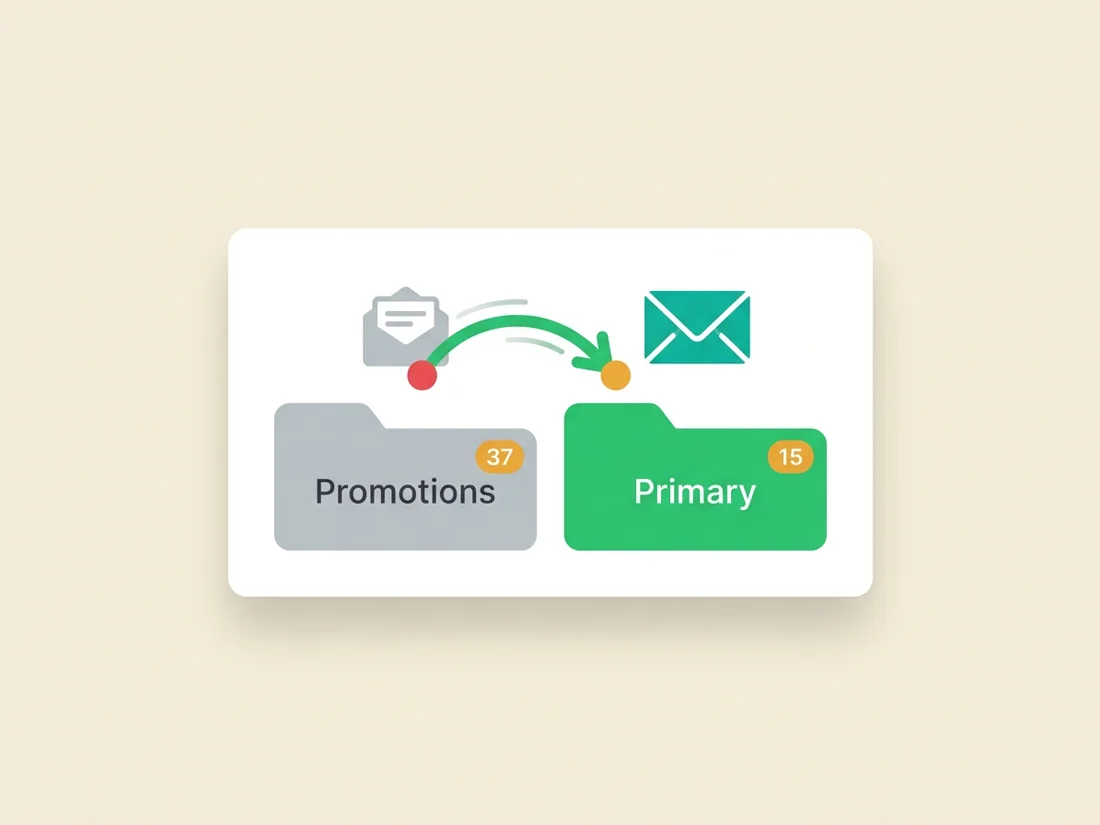
But delivered and seen are not the same thing. There is no notification for Promotions. The reader has to actively open their mail app and switch tabs to find you. Most never do. So a mail that lands in Promotions gets a fraction of the attention of the same mail in the primary inbox, and your open and reply numbers quietly reflect that. For cold email the stakes are even higher, because the fight there is usually primary versus spam, not primary versus Promotions, and the same forces decide both.
What barely moved the needle
Two of the most common pieces of advice did almost nothing in testing.
- Stripping emails down to plain text. We went as minimal as possible, no images, no buttons, and still landed in Promotions. Format mattered far less than expected.
- Chasing spam trigger words in subject lines. Rewriting subjects to avoid the usual list of scary words barely changed placement. Modern filters do not work off a word blacklist.
This is the first clue. If format and wording are not the problem, the problem is somewhere else: reputation and engagement. Design still has a floor to clear, and the design and deliverability rules cover it, but past that floor the tab is decided by other signals, part of the same machinery behind Gmail's 2026 filtering changes.
The biggest lever: send by engagement, not all at once
This was the single biggest change, and nothing else came close.
Gmail watches how engaged your recipients are with you. When you blast your entire list in one shot, you mix your most active readers in with people who have not opened you in months, and the average engagement signal drags you down. So instead, send to your most recently engaged readers first, let that strong early signal register, then widen out to the rest of the list in waves.
The active readers open, reply, and interact quickly. Gmail reads that as evidence that people want your mail, and it carries that reputation into the later waves. The mechanism is the same one that decides cold email placement: providers reward senders whose recipients clearly want to hear from them. Engagement-first sending is how you show them that on every send.
If you run cold email rather than a newsletter, the same idea applies to your follow-ups and re-engagement. Lead with the segments most likely to reply, and never pour cold, unproven volume through a mailbox before it has earned the reputation to carry it.
Cut the tracking links
Redirect and click-tracking links hurt more than images ever did. Trimming them helped more than any design change we made.
Click trackers wrap your links in a redirect domain, and open trackers embed an invisible pixel. Both are signals filters strongly associate with bulk marketing mail, and a redirect domain with a weak reputation can pull your whole message down with it. The usual objection is that you need those links to measure results. You do not. Seed-based placement testing tells you where you land, and real replies tell you what is working, without a single pixel. Trade the vanity metric for the inbox.
Make it look like a person sent it
The mail that performed best read like it came from a human, not a broadcast system.
- A real reply-to address that a person actually monitors, not a no-reply.
- A conversational tone instead of a designed campaign template.
- A genuine question at the end so people actually reply.
The replies turned out to matter a lot, and they snowballed. A reply is one of the strongest positive signals a mailbox provider can see, because almost no one replies to spam. Every reply you earn makes the next send land a little better. This is exactly why good cold email asks a real question and sends from a monitored inbox: you are farming replies, and replies are reputation.
Consistency beats bursts
Random bursts of volume looked campaign-like and got treated that way. A steady rhythm helped Gmail read the sender as a normal correspondent rather than a broadcaster.
Pick a cadence you can hold and hold it. Sudden spikes, long gaps, then another spike are a classic bulk-sender pattern. A predictable, human pace builds trust over time, and trust is what buys you the primary inbox.
See where you land before your readers do
The final change was the simplest, and it removed all the guesswork. Before every send, run a seed-based inbox placement test.
You send the email to a set of seed accounts spread across Gmail, Outlook, and Yahoo, and you see exactly where it lands, primary, Promotions, or spam, per provider, before your real list ever sees it. Instead of finding out from a flat open rate the next morning, you find out in minutes and fix it first. Once you can see placement directly, every other lever on this list becomes measurable instead of a guess.
The real shift is mental
One honest caveat before the close: for some senders the Promotions tab is simply home turf. Retail and ecommerce email programs live there natively, and for them the better play is winning inside the tab rather than fighting it. The lesson underneath all of this: escaping Promotions is a reputation and engagement problem, not a design problem. Once you stop tweaking colors and buttons and start optimizing for how much your recipients genuinely want your mail, the numbers follow. Authenticate your domain, keep your list clean, lead with engaged readers, earn replies, hold a steady cadence, and measure placement directly. Do that and the tab takes care of itself.
How SpamCipher does the hard parts for you
Everything above works, but doing it by hand on every send is a lot of manual discipline. SpamCipher is built to run this system for you, on one platform.
- Seed-based inbox placement on demand and on a schedule, so you always see primary versus Promotions versus spam per provider before and after you send.
- Warm-up and engagement-aware pacing that builds reputation and leads with your strongest signal instead of blasting everything at once.
- Verification that strips dead addresses before they bounce and drag your reputation down.
- Continuous reputation, blacklist, and DMARC monitoring, with an always-on guard that throttles or pauses a mailbox before a bad send burns your domain.
- Reply and placement signals instead of open pixels, so you can drop the tracking links that hurt you and still measure what matters.
And this is no longer a promise: the "Deliverability-first" preset is now live in SpamCipher. One click turns on cleaner links (open pixel off, no click-tracking rewrite), a capped sending cadence, a pre-send placement gate that blocks launch until you land in the inbox, and engagement-first send order so your strongest recipients lead every send. All of it is on by default and still yours to tune, right in the campaign settings.
Stop guessing where your email lands
SpamCipher tests real inbox placement, warms and paces your sending, verifies your list, and protects your domains automatically. Full-loop cold email and deliverability, with unlimited mailboxes and sending on SpamCipher ONE.
See where you land, free