
A spam trap is an email address that exists only to catch senders with bad habits. You cannot see them in your list, they look exactly like every other address, and a single one can quietly drag down your deliverability. Here is what they are, why they matter, and the practical steps that keep them out of your reach.
What spam traps actually are
Spam traps, sometimes called honeypots, are addresses operated by blocklist providers and mailbox providers for one purpose: to identify senders who are not following good list practices. Nobody ever signs up to a newsletter with a spam trap, and nobody ever reads the mail it receives.
That is exactly what makes them useful to the people who run them. A legitimate, permission-based list should never contain an address that did not opt in. So when mail arrives at a trap, it is a strong signal that the sender either bought a list, scraped it, or has let their data go stale. The address never engages, never clicks, and never replies, because there is no human on the other end.
Organizations like Spamhaus maintain large networks of these addresses and feed what they learn into the blocklists that mailbox providers consult before deciding where your mail lands. In short, a spam trap is a tripwire, and you usually do not know you have stepped on it until your delivery starts slipping.
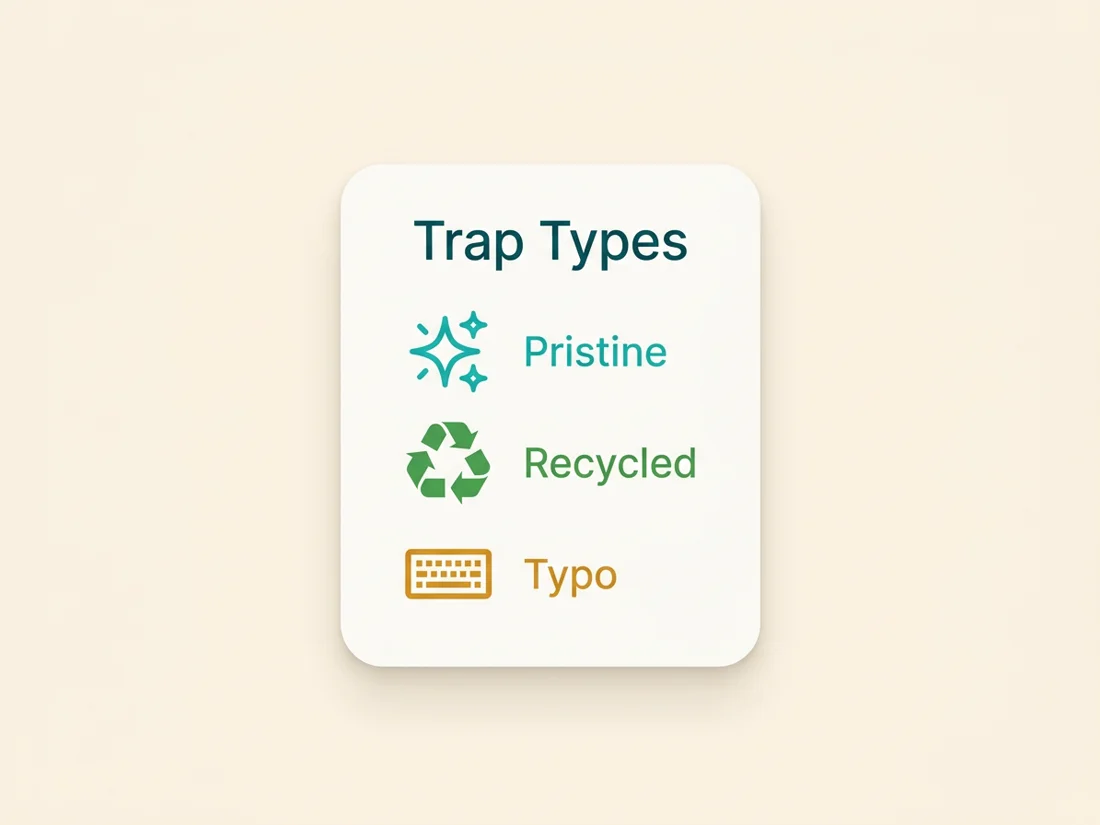
The three main types of spam traps
Traps are not all the same, and understanding the differences explains how they get onto a list in the first place. There are three common types.
Pristine traps. These addresses have never belonged to a real person. They are created purely to catch spammers and are often seeded quietly across the web, hidden in page code where only an automated scraper would find them. Because a pristine trap could only reach your list through scraping or a purchased list, mail to one is treated as a near-certain sign of abuse. Pristine traps are the most damaging, and reaching one can get a domain or IP blocklisted quickly.
Recycled traps. These were once genuine, active addresses that a real person used and then abandoned. After a long period of inactivity, the provider reclaims the address and converts it into a trap. General practice is that an address must sit dormant for at least 12 months before it is reused this way. Recycled traps are the provider's way of catching senders who never prune the contacts who stopped engaging; they are the final stage of email list decay, where an address that quietly died on your list gets reborn as a tripwire.
Typo and role traps. Typo traps are built from the everyday mistakes people make when typing an address, such as gmial.com instead of gmail.com, or a missing letter in a common domain. Some providers register these lookalike domains specifically to catch mail sent to fat-fingered addresses. Closely related are role and data-entry errors that slip in through forms without confirmation.
Why hitting one is so damaging
The damage from a spam trap is out of proportion to the single message that triggered it. Mailbox providers and blocklist operators treat trap hits as one of the clearest indicators that a sender cannot be trusted, so the consequences cascade.
- Your sender reputation drops, and reputation is the main thing that decides whether you reach the inbox.
- Your domain or sending IP can be added to a blocklist such as the ones Spamhaus publishes, which many providers check before accepting mail.
- Once listed, even your mail to genuine, engaged subscribers can be diverted to spam or rejected outright.
A pristine trap can do this with a single hit, because there is no innocent explanation for how it reached your list. Recycled traps are usually judged in context, but a pattern of them still tells the provider your hygiene has slipped. To understand how trap hits feed into the bigger picture, see our guide to sender reputation, and if a listing has already happened, the blacklist removal playbook walks the way back out.
How traps end up on your list
Spam traps do not appear by magic. They arrive through the same shortcuts and oversights that hurt deliverability in general. The most common routes are:
- Buying or renting lists. Purchased lists are the single biggest source of pristine traps, because you have no idea how the addresses were collected or whether anyone consented.
- Scraping addresses from websites or directories, which is exactly the behavior pristine traps are designed to catch.
- Skipping opt-in confirmation, which lets typos and bogus addresses enter through your own sign-up forms.
- Ignoring hard bounces. Leaving dead addresses on your list is how a once-valid address can later turn into a recycled trap under your nose.
- Letting lists go stale. Contacts who stopped engaging years ago are the most likely to have their addresses recycled into traps.
How to keep traps off your list
You cannot pull traps out one by one, but you can build habits that stop them from getting in. Every one of these also improves deliverability on its own.
- Collect with permission, and use double opt-in. Asking new subscribers to confirm their address weeds out typos and fake entries before they ever reach your list.
- Never buy or rent a list. There is no safe way to do it, and it is the fastest path to a pristine trap.
- Verify addresses before you send. A real email validation pass catches invalid addresses and obvious typo domains so they are removed up front, well before they can do damage.
- Remove hard bounces immediately. A hard bounce means the address is dead, and a dead address is a future recycled trap if you keep mailing it.
- Re-engage or sunset inactive contacts. Run a win-back campaign for people who have gone quiet, then drop the ones who do not respond. Old, unengaged contacts are exactly where recycled traps hide.
If your list has been sitting untouched for a while, the safest first move is a thorough cleanup. Our walkthrough on how to clean your email list the right way covers the full process.
The honest truth about detecting traps
Here is the part many vendors gloss over: you cannot reliably detect spam traps directly. By design, they look identical to ordinary addresses. They have valid syntax, they sit on real mail servers, and they accept mail. No tool can look at a single address and tell you with certainty that it is a trap, and any product that claims to "scan for spam traps" is overstating what is technically possible.
That is why prevention, not detection, is the real defense. The goal is not to find the traps you already have, but to keep them from ever entering your list and to age out the conditions that create recycled traps.
This is where verification earns its place. SpamCipher is the cold email platform for unlimited, automated sending, and it protects the domains it sends from. It cannot point at an address and label it a trap, but it can do the things that genuinely reduce your exposure: confirm that an address is properly formatted, flag misspelled and lookalike domains before they reach your list, and identify the invalid and undeliverable addresses that signal a list has gone stale. Pair that with permission-based collection and prompt bounce removal, and you close off the routes traps use to get in. To catch a listing fast if one ever slips through, keep an eye on blacklist monitoring as well.
Reduce your spam-trap exposure
Verify your list to catch invalid and typo addresses before they reach a trap, and monitor your domain's reputation in one place.
Get started free