
A blacklist listing rarely announces itself. Your mail just starts landing in spam, or bouncing, and by the time you notice, the damage is already spreading. This guide explains how email blacklists work, the lists that matter, and why monitoring them is the difference between a quick fix and a quiet disaster.
What email blacklists actually are
An email blacklist (more precisely a DNSBL, or DNS-based blocklist) is a published list of IP addresses or domains with a poor reputation for sending spam. Mailbox providers and spam filters query these lists in real time during the email transaction. When your sending IP or domain shows up on one, the receiving server can reject the message outright, route it to the spam folder, or add weight against you in a wider scoring decision.
It helps to split the lists into two families. Some target the IP address your mail server connects from. Others target the domains and links that appear inside the message, which catches the websites a spam campaign is trying to promote even when the sending IP looks clean. Knowing which family flagged you tells you where to look for the problem.
The major lists and what each targets
A handful of operators carry most of the weight. They do not all measure the same thing, so understanding each one helps you read a listing correctly.
Spamhaus runs several lists, often queried together as the combined ZEN zone. The SBL (Spamhaus Blocklist) lists IPs that appear to be controlled by or available to spammers. The XBL (Exploits Blocklist) lists IPs showing signs of compromise, such as infected or hijacked machines. The PBL (Policy Blocklist) lists end-user IP ranges that should not be sending mail directly to other servers, which is why home and dynamic addresses belong there. The DBL (Domain Blocklist) lists domain names with poor reputations rather than IPs, so it catches the domains seen in message content.
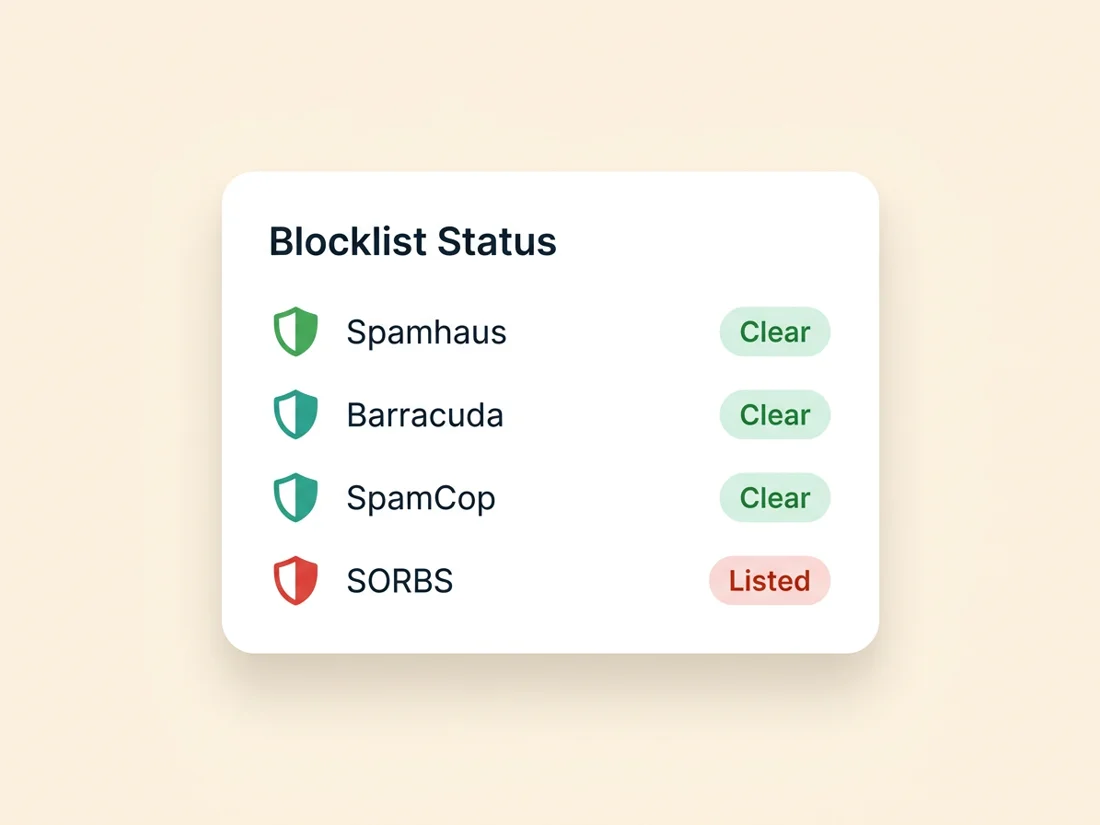
Barracuda publishes the Barracuda Reputation Block List (BRBL), an IP-based list maintained by Barracuda Central that scores sending sources by observed behavior. SpamCop operates the SpamCop Blocking List (SCBL), an automatic, time-based IP list fueled by user reports and spam traps, which is known for listing and delisting quickly as reports arrive and age out. SURBL is different in kind: it is a URI list that flags the domains and links found in message bodies, so it works on content rather than the sending IP. Invaluement is a smaller, well-regarded set of add-on lists, with ivmSIP and ivmSIP/24 targeting IPs (notably the elusive snowshoe spammers who spread volume across many addresses) and ivmURI targeting spam-associated domains.
How senders end up listed
Legitimate senders get listed far more often than people expect, usually for one of a handful of reasons. The good news is that every cause has a clear fix.
- Spam-trap hits. Blocklist operators seed hidden addresses that should never receive mail. Hitting one signals scraped or purchased lists, or stale contacts you never cleaned up; spam traps and how to avoid them covers the full mechanics.
- Sudden volume spikes. A new IP or domain that jumps from a trickle to a flood looks like abuse. Warming up gradually avoids tripping that signal.
- Compromised accounts. A hacked mailbox quietly blasting spam is one of the most common ways a trustworthy sender lands on a list.
- High complaint rates. When too many recipients hit "report spam," the lists and the mailbox providers both take notice.
- Poor list hygiene. Invalid addresses, hard bounces, and unengaged contacts all push your reputation in the wrong direction.
- Open relays or misconfigured servers. A mail server that lets strangers relay through it will be exploited and listed quickly.
How to check, and what a listing costs you
Checking whether you are listed means querying your sending IPs and your domains against the major lists. A clean result on all of them is what you want. The impact of a listing depends on which list flagged you and how aggressively your recipients' providers use it.
At the harsh end, a listing on a widely consulted IP list can get your mail rejected at the door, so messages never arrive at all. More commonly it costs you the inbox: your mail is accepted but quietly filed under spam, where almost no one sees it. Even a single content-based listing, such as a flagged link domain, can drag down an otherwise healthy campaign because the problem rides along inside every message.
Because mailbox providers like Gmail also fold sender reputation signals into their own filtering, a blacklist hit rarely stays contained. It feeds the same machinery that decides inbox versus spam, which is why catching it early matters so much.
How to get delisted
The order of operations is what trips people up. Fix the root cause first, then request removal. Submitting a delisting request while you are still sending the spam, leaking from a compromised account, or running an open relay almost always results in an immediate relisting, and repeated requests can get you flagged as noise.
Each operator handles removal differently. Some lists, like SpamCop's, are time-based and clear on their own once the reports stop and age out, so patience is often the right move. Others, like Barracuda and Invaluement, use a manual removal form and expect a genuine explanation and real contact details before they act. Expect cooldown periods either way. A first listing usually clears faster than a repeat offense, so the cleanest strategy is to never earn the second one. For the complete operator-by-operator process, honest timelines, and the recovery ramp after removal, work through the email blacklist removal playbook.
Before you file any request, confirm the basics: your server is no longer sending spam, any compromised account is secured, and you authenticate properly with SPF, DKIM, and DMARC. If those terms are new, our complete guide to email authentication walks through each one.
Why continuous monitoring wins
Most senders discover a listing the worst possible way: through a spike in bounces, a drop in opens, or a customer asking why your replies never arrive. By then you have been listed for days, your reputation has already softened, and you are reacting under pressure instead of fixing a small problem.
Continuous monitoring flips that around. Instead of finding out from a bounce, you find out the moment a list flags you, while the cause is still fresh and easy to trace. That head start is often the difference between a quiet delisting and a multi-week reputation repair.
SpamCipher is the cold email platform for unlimited, automated sending, and blocklist monitoring is one guardrail on the owned pipeline behind its 90%+ inbox placement: it watches every sending IP and domain you send from across the major blocklists and alerts you as soon as a listing appears, so you can fix the root cause and request removal before your recipients (or Gmail) ever notice. Pair that with steady list hygiene and you spend far less time firefighting. See how to clean your email list the right way for the upstream half of the work.
Know before Gmail does
Monitor every domain and IP you send from across the major blocklists, and get alerted the moment something changes.
Get started free