
Hiring a cold email agency looks like a marketing decision and is actually a risk decision: you are handing a third party the keys to your market's inboxes, and if they drive badly, the reputation damage lands on assets with your name on them. Plenty of agencies are genuine operators who will out-execute an in-house build; plenty of others are list-blasters with a pitch deck, and the difference is invisible in the sales call unless you know what to ask. This guide is the vetting kit: the honest in-house-versus-agency framework, the ownership question that matters more than price, ten questions with what good answers sound like, and the red flags that end conversations. We are SpamCipher, an AI-powered sales engagement platform, B2B lead intelligence database, and email deliverability and security suite in one product; agencies run client campaigns on our platform, so we see both the operators and the wreckage, and this article is written from that vantage point.
When a cold email agency makes sense
Start with the honest fork, because an agency is not automatically the right answer. Three variables decide it.
- Time to competence. Cold email done properly is a system: domains, warm-up, verification, copy, sequencing, reply handling, compliance. An in-house build takes a motivated person roughly a quarter to get competent and longer to get good (the whole curriculum is our how to send cold email guide). A real agency arrives with the system already built. If pipeline is needed this quarter and nobody owns outbound today, the agency buys you the calendar.
- Volume and economics. Below a certain scale (one founder sending a few hundred researched emails a month) an agency's retainer usually exceeds what the motion earns, and the founder's authentic voice is the asset an agency cannot replicate. Above it (multiple segments, thousands of prospects monthly, an SDR team to feed) the specialist's efficiency starts winning. The crossover for most B2B companies sits somewhere around the point where outbound needs to be someone's full-time job and nobody wants it.
- Learning intent. If outbound will be a core motion for years, the agency should be a bridge, not a permanent outsource: you want the playbook, the data, and the learnings accruing to you. If outbound is an experiment or a side channel, permanent outsourcing is fine. Decide which movie you are in before the first call, because it changes what contract you should sign.
Run the economics explicitly rather than by feel. An in-house build costs a salary (or a meaningful slice of one), plus tooling, plus the quarter of ramp time before results; a typical agency engagement costs a retainer in the low-to-mid four figures monthly with results starting inside the first month. Over a year the totals often land closer than either side's sales pitch admits, which is why the deciding variables are usually the softer ones: whether the learning stays, whether anyone internally wants to own the motion, and how expensive a quarter of delay is to your pipeline. Put real numbers in a two-column sheet before any agency call, because the sheet also becomes your negotiating anchor.
There is also a middle path worth naming before the vetting begins: keep the strategy and copy in-house, and outsource only the infrastructure (domains, mailboxes, warm-up, DNS) through a done-for-you setup. It captures most of the time savings at a fraction of the cost and none of the ownership risk, and we compare the models honestly in BYO vs done-for-you infrastructure.
What a good agency actually does
To vet the pitch, know what the real product is. A competent cold email agency delivers five functions, and weakness in any one shows up in your results within a quarter.
- ICP definition and list building: turning "companies like our best customers" into a researched, verified prospect list, with sourcing they can explain and verification they actually run rather than claim.
- Infrastructure operation: provisioning and warming sending domains, keeping authentication enforced, pacing volume, and watching bounce and complaint signals daily. This is the invisible 60% of the job and the part list-blasters skip.
- Copy and sequencing: message-market fit work, not template rotation: research-led first lines, follow-ups that add reasons, and sequences with real exits.
- Reply handling and handoff: triaging responses fast (interested replies decay by the hour), booking meetings, and handing conversations to your team with context.
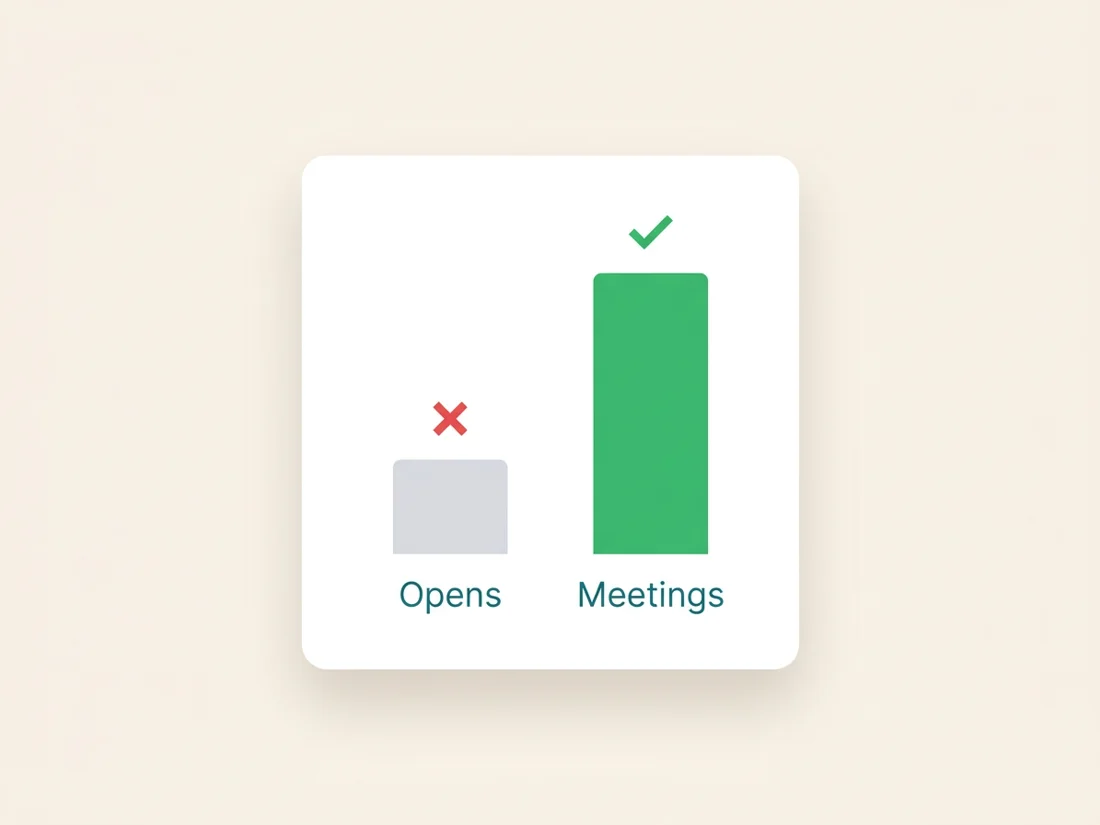
- Reporting that maps to revenue: replies, positive-reply rate, meetings, and pipeline per segment, not a monthly PDF of open rates.
Notice what the list implies: most of the value is operational discipline on deliverability infrastructure. Copy is the visible craft; the inbox is won underneath it, which is exactly why the next section is the one that decides your shortlist.
The ownership question: whose reputation, whose assets
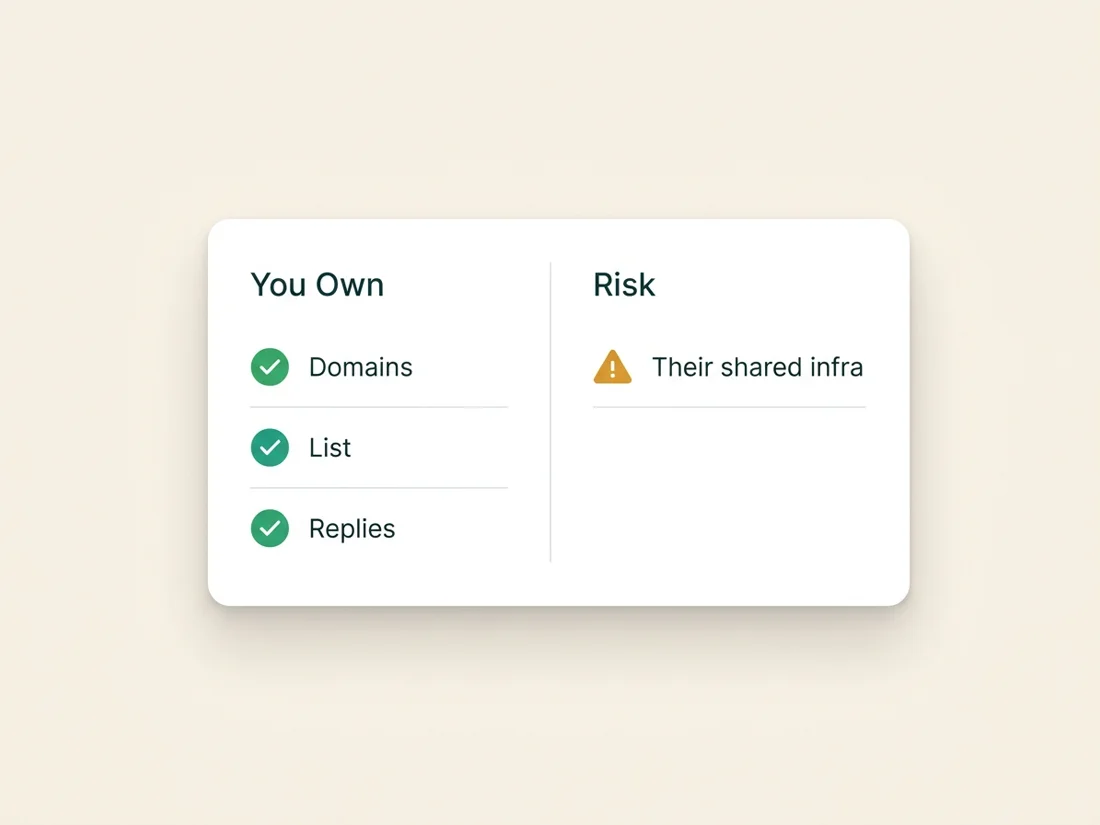
One structural question separates safe engagements from dangerous ones, and most buyers never ask it: who owns what, during the contract and after it? Three assets are at stake.
The sending domains and their reputation. The safe pattern is dedicated sending domains provisioned for you, owned or transferable to you, and separate from your primary company domain. The dangerous patterns are two: sending from the agency's shared infrastructure, where another client's spam complaint throttles your campaigns and their accumulated sins become your placement; or sending directly from your primary domain, where a bad quarter of outbound poisons the domain your invoices and support mail depend on. Reputation attaches to domains, as we cover in why switching ESPs won't fix deliverability, and the contract decides whose domains carry the risk.
The list and the data. Every prospect researched, every reply received, every suppression recorded: at contract end, do these export to you cleanly, or do they live in the agency's tooling as a retention lever? A legitimate agency treats data portability as table stakes; a lock-in shop treats your own pipeline history as their moat.
The learnings. Which segments replied, which messages worked, what the real benchmarks were: insist on visibility into the working system, not just monthly summaries, so that whatever you pay for becomes institutional knowledge you keep.
Translate the principle into contract language before signing, because goodwill does not survive a dispute. Four clauses do the work: sending domains registered in your name or with a written transfer obligation at termination; a data-export commitment covering prospects, replies, suppression lists, and sequence content in standard formats within a fixed number of days; a warranty that campaigns will not run on infrastructure shared with other clients; and an audit right to see placement and bounce reporting on request. A legitimate agency agrees to all four without friction, and the ones that push back on them are answering your vetting questions early.
The ten questions that vet any cold email agency
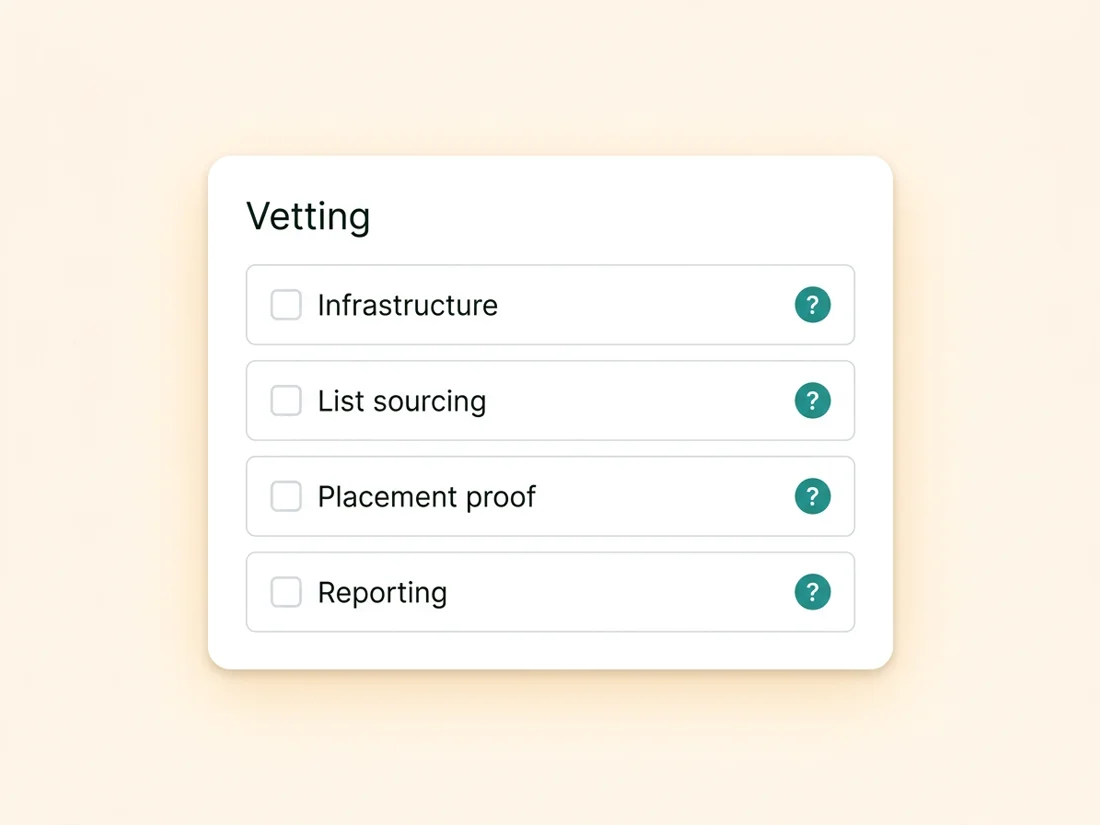
Ask all ten. Good agencies enjoy these questions, because the questions are the difference between them and the shops undercutting them.
- 1. "Whose domains and mailboxes will my campaigns send from?" Good: dedicated domains provisioned for you, transferable at exit, warmed before volume. Bad: "we handle all that on our infrastructure," which means shared reputation you cannot see.
- 2. "Where do prospect lists come from, and what happens before an address gets mailed?" Good: named data sources plus verification on every list before sending, with catch-alls held. Bad: vagueness, "our proprietary database," or any admission of purchased lists.
- 3. "What volume will you send in week one?" Good: a ramp plan that starts small on fresh domains and scales with reply and bounce data. Bad: thousands on day one, which announces they either do not understand warm-up or plan to burn domains as consumables.
- 4. "How do you measure inbox placement?" Good: seed-based testing across Gmail and Microsoft, with placement numbers per campaign. Bad: "our open rates are strong," which measures nothing since opens broke, and doubly nothing behind corporate gateways.
- 5. "How do you handle compliance across the US, EU, and Canada?" Good: a real answer distinguishing CAN-SPAM, GDPR legitimate interest, and CASL, with per-country segmentation (the standard our compliance guide sets). Bad: "cold email is legal, don't worry."
- 6. "How fast do suppressions propagate, and are they global?" Good: instant, across all campaigns and clients' shared targets, honored forever. Bad: any hesitation, because a mishandled opt-out becomes your legal exposure.
- 7. "What is in the monthly report?" Good: replies, positive-reply rate, meetings booked, pipeline influenced, segment by segment. Bad: opens and clicks as headline numbers; you are buying meetings, not opens.
- 8. "How does pricing map to my outcomes?" Good: a clear model (below) with incentives explained honestly. Bad: pricing that rewards volume sent rather than conversations started.
- 9. "What is the minimum term, and what leaves with me at exit?" Good: quarterly commitments, full export of list, replies, suppressions, and domains. Bad: annual lock-ins with vague exit language.
- 10. "Which clients in my segment can I speak to?" Good: two or three references with businesses shaped like yours. Bad: logos on a slide and no phone numbers.
Know what a healthy engagement looks like on the calendar, too, so you can spot drift early. Weeks one and two are infrastructure and ICP: domains provisioned and entering warm-up, target segments defined, list building started with verification, zero campaign volume (an agency sending real volume in week one failed question three). Weeks three and four: warm-up completing, first small test sends to the strongest segment, seed placement baseline measured. Month two: iterate on message-market fit with reply data, expand the winning segment, kill the losers. Month three: scale volume on the proven combination and set the ongoing rhythm of quarterly re-validation and placement checks. Meetings promised in week two are a vanity trick sold to impatient buyers; a measured placement baseline in week four and a clear reply-rate trend by month two are the actual marks of an operator. If the calendar you are pitched front-loads volume and back-loads measurement, you have learned what you needed to.
Pricing models and red flags
Three pricing shapes cover the market, each with a known failure mode. Monthly retainer (commonly a few thousand dollars for one or two segments) buys steady operation; its risk is complacency, so pair it with the reporting standard from question seven. Per-meeting pricing sounds perfectly aligned and quietly optimizes for meeting quantity over quality; expect some show-rate and fit disputes, and define a "qualified meeting" in writing before signing. Hybrid (smaller retainer plus per-meeting bonus) balances both and is what most healthy engagements converge on. Whatever the model, run the math in cost-per-meeting terms against your other channels, using the method in cost per meeting; it is the one number that makes agency, in-house, and paid acquisition comparable.
And the red flags that should end the conversation regardless of price:
- Guaranteed meeting counts before seeing your ICP. Nobody honest guarantees outcomes against an unknown market; the guarantee is being financed by volume you will regret.
- Purchased or "licensed" lists anywhere in the sourcing story. Pre-decayed, consent-free, trap-salted; the damage lands on domains associated with you.
- "You never need to see the sending." Opacity is not a convenience feature; it is where shared infrastructure, skipped verification, and spam-adjacent tactics live.
- No verification step they can describe. An agency that cannot explain how addresses get validated before sending is telling you bounce management is your future problem.
- Growth-hack vocabulary: fake "Re:" threads, scraped personal addresses, inbox-rotation tricks pitched as cleverness. Tactics that trade your reputation for their short-term reply rate.
The transparency alternative
The single upgrade that fixes most agency risk is structural rather than contractual: run the engagement on a platform you can see. When the agency operates inside an account you have access to, every question above becomes verifiable instead of trusted: the domains are visibly yours, the validation step visibly runs before every campaign, placement is a seed-measured number on a dashboard rather than a claim in a deck, suppressions are inspectable, and at exit the assets are already in your hands because they never left them. The agency still brings the skill; the platform removes the opacity that lets bad actors hide. It also quietly improves the good agencies, because operators do their best work when the client can see the dashboard, and the ones who prefer the dark were never going to pass your ten questions anyway.
That model is how our agency program works: agencies run client campaigns on SpamCipher in separate workspaces, with a Viewer role and shareable read-only reports for the client, mailboxes connected or set up through done-for-you ($4 per mailbox a month plus $15 per new domain), and the same platform everything else here runs on: verification before the first send, warm-up on SpamCipher's own seed network, a Deliverability Agent that throttles or pauses a mailbox when complaints or bounces spike, and seed-based placement tests across the providers that matter. It is the arrangement we would demand as a buyer, which is why we built it as a seller, and it works the same whether the hands on the keyboard are yours or your agency's. Choose an operator, insist on ownership, verify with the ten questions, and put the whole thing somewhere you can watch it run.
Whoever runs it, you should be able to see it
Separate workspaces, shareable read-only reports, verification on every list, and seed-measured placement. The transparency layer for agency engagements, with unlimited sending on SpamCipher ONE, every mailbox kept inside its own daily cap.
See the agency program