
Choosing between BYO and done-for-you cold email infrastructure comes down to one honest question: do you want to run the plumbing, or do you want to run the campaign? Both can land in the inbox. The difference is who buys the domains, configures the DNS and authentication, provisions the mailboxes, and babysits the warm-up, you, or a platform that does it for you and isolates you from everyone else. SpamCipher is the cold email platform for unlimited, fully automated cold email, and we are the only platform that can promise you 90%+ inbox placement, because we own the whole pipeline whichever way you set it up. This guide is deliberately balanced: it tells you when BYO is the right call and when done-for-you wins, so you pick the model that actually fits your team.
What BYO cold email really takes
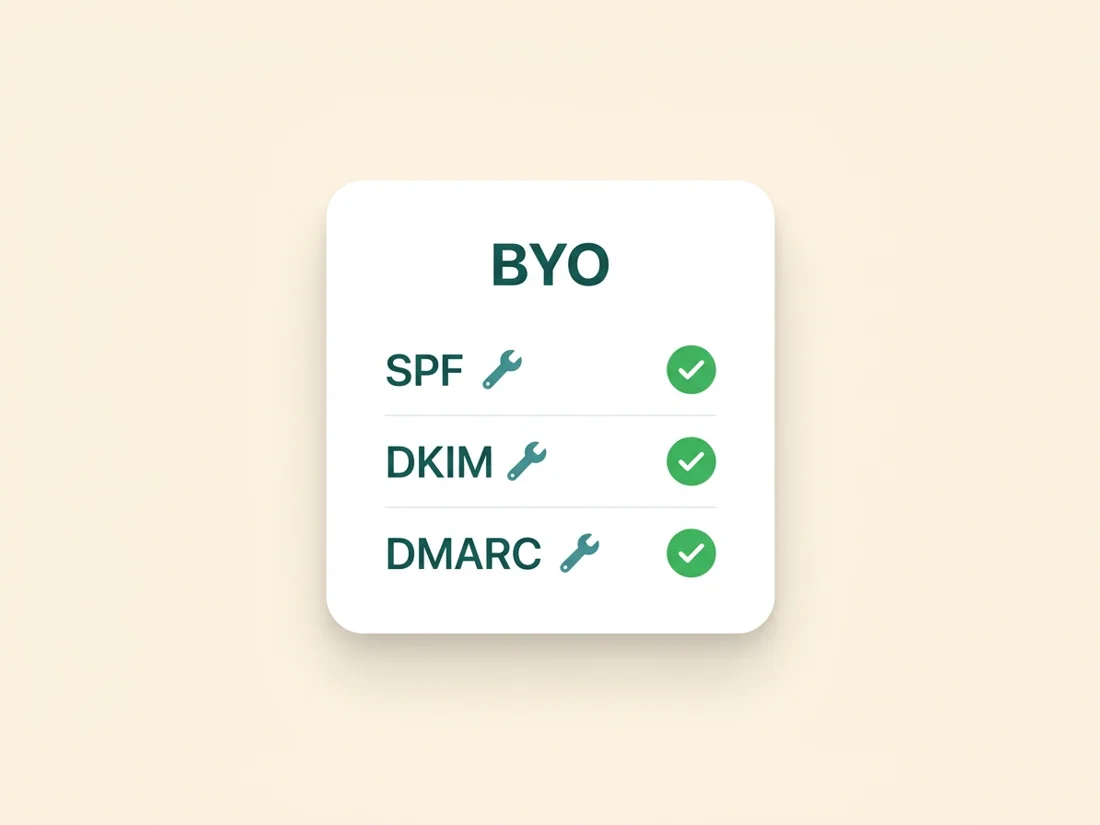
BYO cold email means you bring your own cold email infrastructure: you register the sending domains, stand up the mailboxes, publish the authentication records, and run the warm-up yourself. Done well, it gives you total control and the lowest per-mailbox cost. Done casually, it is the single most common reason cold email dies in spam. Here is what the job actually involves, start to finish.
- Buy sending domains. You register lookalike domains kept separate from your primary brand domain, so a reputation problem on the cold channel never touches the address your customers already trust. Most senders run several.
- Configure DNS and authentication. On every domain you publish SPF, a DKIM key pair, and a DMARC policy, plus the MTA-STS and tracking records if you want them. This is provider-aware work: the exact records differ depending on whether the mailboxes live on Google, Microsoft 365, or another host. Get one record wrong and the domain fails authentication silently. If any of this is unfamiliar, start with our 2026 email authentication guide.
- Provision the mailboxes. You create the actual sending accounts, typically around three per domain to spread load, connect each by OAuth or app password, and store the credentials somewhere safe.
- Warm every domain and mailbox. New domains have no reputation, so you ramp them over two to four weeks on a real warm-up network before real volume, watching placement daily. Skip it and you torch a cold domain in a day. Our guide to email warm-up for new domains covers the ramp.
- Maintain it forever. Domains renew, DKIM keys rotate, DMARC reports need reading, and blacklists need watching. BYO is not a setup task, it is an ongoing operations job.
None of this is exotic, but all of it is exacting, and it never really ends. BYO rewards teams that have the technical depth and the time to own the whole checklist. For everyone else, each step above is a place the number can quietly break.
What done-for-you cold email includes
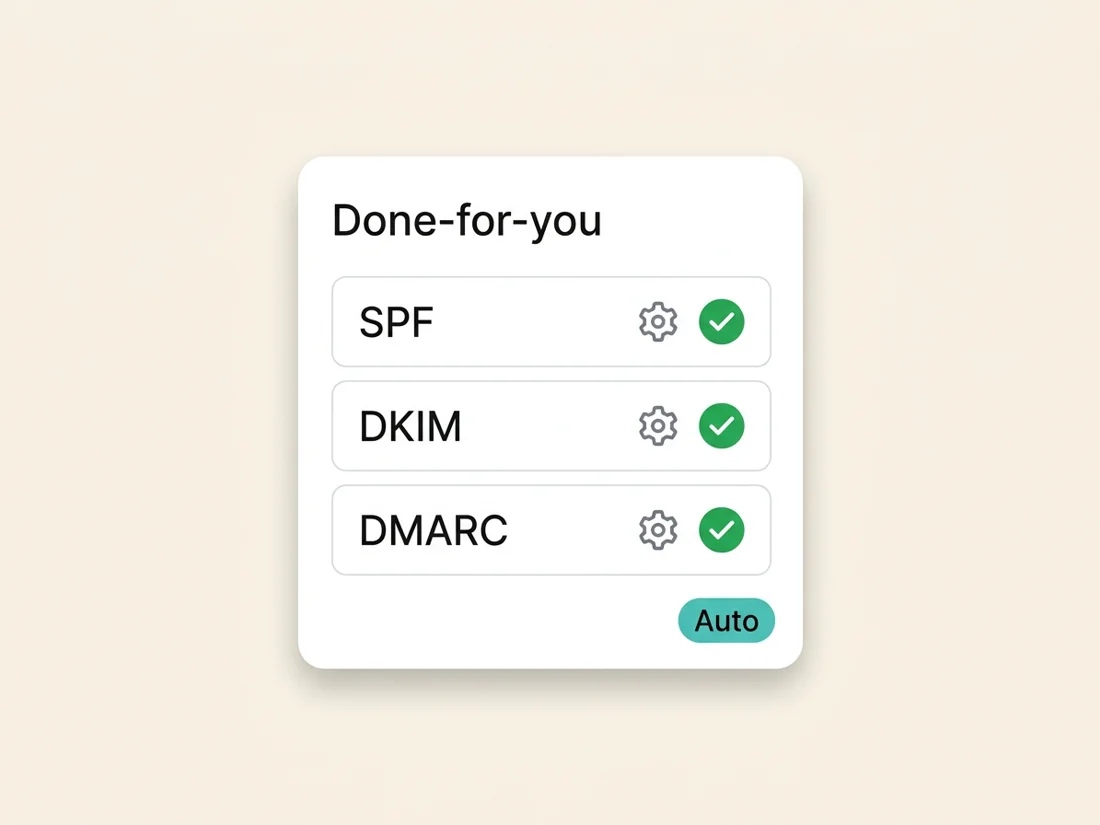
Done-for-you cold email flips the work. Instead of you assembling the infrastructure, the platform provisions it and hands you sending mailboxes that are already authenticated and warmed. Good managed cold email sending is not a black box, it is the same checklist above, run for you and end to end, with nothing left half done. When you evaluate a done-for-you offer, this is exactly what it should include:
- Registrar to domain. You pick an available name and the platform registers it as part of setup, so cold email domains and mailboxes arrive together rather than as a scavenger hunt across three vendors.
- Provider-aware DNS write. The platform publishes SPF, the DKIM keys it generates, DMARC, and the supporting records automatically, correct for the mailbox provider it is using, with no copy-paste into a DNS console at midnight.
- Mailbox provisioning at scale. Real mailboxes are created on a managed provider (Google Workspace, Microsoft 365, or Zoho), roughly three per domain, connected and ready to send.
- Warm-up, handled. Every new domain and mailbox is ramped on a real warm-up network before you send a single campaign, so you inherit reputation instead of building it by hand.
- Per-customer isolation. The most important part, and the one cheap providers skip. Your infrastructure is provisioned as its own tenant, so no other customer's sending can ride on your reputation. More on this below.
Done right, done-for-you cold email compresses a multi-week technical project into a guided setup, and it removes the entire class of quiet DNS and authentication mistakes that sink BYO senders. That is the real product: not "we send for you" (you are still the sender of record), but "we build and defend the infrastructure so you only run campaigns."
BYO vs DFY: how to choose
There is no universally right answer, only the right answer for your team. The honest way to decide is to be clear about what you are optimizing for. Here is the trade-off, plainly.
BYO cold email makes sense when you have a technical person who genuinely understands DNS and authentication, you already own or want tight control over your sending infrastructure, you are willing to treat deliverability as an ongoing operations job, and squeezing the lowest per-mailbox cost matters more than speed. If you have run authenticated senders before and the checklist above reads as familiar rather than daunting, BYO gives you maximum control and the cheapest marginal mailbox.
Done-for-you wins when you want to be sending in days rather than weeks, you do not want to touch a DNS console, you are scaling past a handful of domains where the manual work stops being tractable, or you simply want the isolation guarantee that a shared setup cannot give you. DFY trades a little per-mailbox cost for speed, for zero DNS headaches, and, crucially, for the reputation isolation covered in the next section. For most teams whose core business is not email operations, that trade is obvious.
A useful gut check: BYO is choosing to own a car and do your own maintenance; done-for-you is a serviced fleet that shows up ready to drive. Both get you there. One asks for your weekends. Whichever you choose, the discipline underneath is identical, verify the list, warm before you send, and measure real placement, which we walk through end to end in how to send cold email.
The isolation that matters
This is the part that separates a serious done-for-you cold email setup from a cheap one, and it is where a lot of managed offers quietly cut the corner that costs you most: per-customer tenant isolation.
The failure mode is shared infrastructure. If a provider drops every customer's mailboxes into one shared organization or tenant, then every customer shares a blast radius. One aggressive sender who blows past complaint thresholds, one spammy list, one domain that gets blacklisted, and the reputation damage can bleed onto neighbors who did everything right. You would be paying for done-for-you and inheriting strangers' mistakes.
The correct architecture provisions a separate tenant per customer, each with its own domains and its own roughly three mailboxes per domain, so your sending reputation is yours alone. One customer's behavior cannot touch another's. This is not a nice-to-have, it is the whole point of managed infrastructure: you are buying a clean, isolated slice, not a seat in a crowded room. When you evaluate any done-for-you offer, ask exactly one hard question, "are my mailboxes isolated in their own tenant, or pooled with other customers?" The answer tells you whether you are buying protection or exposure.
SpamCipher provisions per-customer, isolated tenancy by design, so one customer's reputation can never hurt another's. It is the same principle behind owning your whole channel, which we make the full case for in own your cold email pipeline.
One platform, either way: BYO or done-for-you cold email
Here is why the BYO versus DFY debate matters less on SpamCipher than anywhere else: we offer both, on one owned pipeline. Bring your own domains and mailboxes and we authenticate, warm, and defend them. Or let us provision the whole thing, registrar to provider-aware DNS to mailbox creation on Google, Microsoft 365, or Zoho to warm-up, isolated in your own tenant. Either path lands in the same place, a warmed, authenticated, measured fleet feeding one campaign engine.
That single owned pipeline is exactly why we can make a promise no bolt-on stack can. Whichever way your infrastructure was built, SpamCipher measures where your real mail lands with seed accounts across the major providers, warms your domains on our own network, and auto-throttles or pauses any mailbox whose complaint or bounce rate crosses a safe threshold, before it drags the domain down, not after. Because validation, warm-up, sending, and reputation defense share one dataset and one source of truth, nothing falls through a seam. That is what lets us guarantee the number instead of hoping for it.
So the model you choose, BYO or done-for-you cold email, is a question of who does the setup work, not of what you can promise your prospects. On SpamCipher the ceiling is the same: unlimited, fully automated cold email at 90%+ inbox placement, guaranteed, because we own the pipeline underneath both. Explore the full sending platform on our Domain Health and Outreach surfaces, or just start and let the setup wizard pick the path that fits you.
The only platform that can promise you 90%
BYO or done-for-you, isolated per customer, warmed on our own network, and defended automatically. Send unlimited, fully automated cold email and still land 90%+ in the inbox. One owned pipeline, either way.
Start sending cold email that lands