

Your open rate does not pay rent. Neither does your reply rate, at least not on its own. The one number that actually covers payroll is cost per meeting: what it costs you, in tooling, domains, and hours, to book one real sales meeting from cold email. This is the cost per meeting cold email guide, the metric that pays rent, and it is the lens SpamCipher is built to optimize. We are the cold email platform for unlimited, fully automated cold email, and we are the only platform that can promise you 90%+ inbox placement, which, as you will see, is the single biggest lever on the whole equation. Everything else in your funnel sits downstream of whether your mail was ever seen.
Why cost per meeting is the metric that matters
Walk into most cold email retros and you will hear people celebrate a 55% open rate. It means nothing. Apple Mail Privacy Protection and its imitators pre-fetch images, so opens are inflated on arrival and a chunk of that "engagement" is a machine, not a human. Opens are a vanity metric, full stop.
Reply rate is better, it is a real human response, but in isolation it still lies. A 6% reply rate sounds great until you learn half those replies were "unsubscribe" or "who is this." Replies are an input, not an outcome. The outcome your business actually spends and banks is a booked meeting with someone who could buy, and eventually a closed deal behind it.
That is why cost per meeting (or its stricter cousin, cost per qualified opportunity) is the only metric that pays rent. It rolls every upstream input, spend, deliverability, targeting, and copy, into one honest number tied to revenue. It forces the right question. Not "how do I get more opens," but "what does one real conversation cost me, and how do I make it cheaper." Anchor your entire cold email program to it and the noisy metrics fall into their proper place: as diagnostics, not scoreboards. This is the discipline behind real cold email ROI.
The cost per meeting math
The math is simple, and that is exactly why it is powerful. Cost per meeting is your total program cost divided by the meetings booked in the same window. But the useful version breaks the denominator into the chain of conversion rates that produce a meeting, because that is where you find the leverage.
Walk the funnel from the top. You send a number of emails. A share of them actually land in the inbox, that is your placement rate, and the rest die in spam. Of the ones that land, a share earn a reply, that is your reply rate. Of those replies, a share are positive and convert into a booked meeting, that is your meeting rate. Multiply them and you get meetings per thousand sends. Divide your cost by that and you have cost per meeting.
Put your own measured numbers to it to feel the shape. Take a thousand sends, then three multipliers you have actually observed: the share that lands, the share of landed mail that earns a reply, and the share of replies that become meetings. Multiply the three and you have meetings per thousand sends; divide your spend by that and you have cost per meeting. We deliberately do not quote an industry reply rate to fill those slots, because a benchmark you did not measure is a number somebody else invented, and this article is not going to hand you one. The structure is what is universal: sends, times placement, times reply rate, times meeting rate, equals meetings. Everything you can do to raise one of those middle multipliers, or lower the cost sitting on top, drives cost per meeting down. And notice which multiplier is usually the most broken, and the most ignored.
Where deliverability hides in your cost per meeting
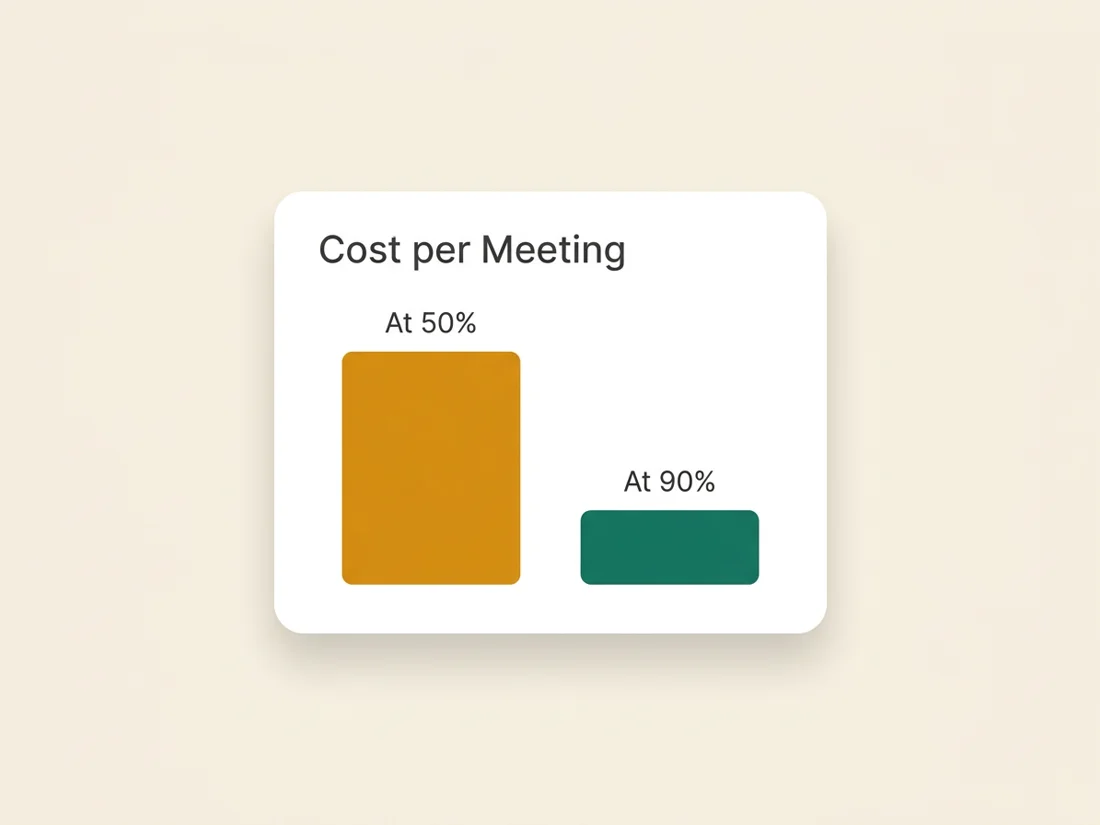
Here is the quiet killer. Placement is a multiplier in the chain just like reply rate, but almost nobody measures it, so its damage is invisible. Mail that lands in spam converts at zero. Zero replies, zero meetings, but you still paid to send it, you still burned the lead, you still spent the rep's time loading the list. A campaign sitting at 50% placement is not "doing okay," it is silently doubling your cost per meeting, because half your spend produces literally nothing and you cannot see the leak.
Think about what that means against the alternative. Take two identical campaigns, same list, same copy, same reply rate on the mail that lands. One places at 50%, one at 90%+. The second books nearly twice the meetings for the same spend, which means its cost per meeting is nearly half. You did not write a better email. You did not find a better list. You just got seen. That is the entire game, and it is why deliverability, not copy, is the first place to look when cost per meeting is too high.
The only honest way to know your placement is to measure it directly with seed accounts across Gmail, Outlook, and Yahoo, not to infer it from an open pixel that privacy features have already poisoned. Ground it in the numbers the providers actually publish: keep spam complaints under 0.3%, which is the line Google's sender guidelines tell bulk senders never to reach, with 0.1% given as the figure to aim for [support.google.com/a/answer/81126, 2026-08-06]. On top of that, aim for placement of 90%+, the number SpamCipher promises, and hold bounces under 2% as a working ceiling of our own. Cross any of those and placement erodes, and your cost per meeting climbs without a single line of the funnel looking obviously broken. We make the full case in how to own the inbox at 90%+, and it is the deliverability spine of this whole argument.
How to drive cost per meeting down
Once you accept that cost per meeting is a chain of multipliers, the playbook writes itself. Fix them in order of leverage, and deliverability comes first because it is both the biggest multiplier and the one most likely to be silently broken.
- Deliverability first, always. Every point of placement you recover is a point of spend converted from waste into pipeline. Measure real placement with seeds, warm your domains before you spend their reputation, authenticate with SPF, DKIM, and DMARC, and defend the number continuously so it does not decay under you. 90%+ placement means every email at least has a chance to convert, and owning the pipeline is what makes that number promisable rather than hoped for.
- Targeting second. A tighter, more relevant list lifts reply rate and meeting rate at the same time, and it slashes waste at the top of the funnel. Verification is the cheap, decisive move here: validating every address before you send stops bounces from wrecking your reputation and stops you paying to email people who do not exist. Fewer wasted sends, lower cost per meeting.
- Copy third. Only after mail lands and the list is right does copy earn its keep. A short, human message with one clear reason to reach out and one ask lifts your reply-to-meeting conversion. But copy sent to spam replies at zero, so this is the last lever, not the first.
- Automation across all three. Rep time is a real cost in the numerator. Automating list import, sending cadence, throttling, and reply routing frees the hours a human would otherwise burn babysitting the machine, so the same headcount books more meetings. Lower cost, same or better output.
Owning the pipeline is what makes this compound. When one platform owns validation, placement, sending, and follow-up, a placement dip triggers a re-warm, a bounce cluster gets caught before it spreads, and a positive reply gets routed without a human watching. That is how pipeline per email goes up and cost per meeting goes down at the same time. The deeper deliverability walk-through lives in how to send cold email, and the placement system itself in own the inbox at 90%+. This is precisely what SpamCipher's verification and automation is built to run as one stack.
The metrics that feed it
Cost per meeting is the scoreboard, but you steer with the diagnostics that feed it. The trick is to read each one as an input to the rent-paying number, never as a goal in itself. Here is the healthy hierarchy.
- Inbox placement: the first multiplier and the biggest lever. Aim for 90%+ measured with seeds. This is the one that silently doubles cost per meeting when it slips, so watch it above everything.
- Spam complaint rate: under 0.1% is the target, with 0.3% as the hard ceiling providers enforce. Cross it and placement collapses, and cost per meeting spikes.
- Bounce rate: under 2%, trending toward near-zero on a verified list. Every bounce is a wasted send you paid for.
- Reply rate: a useful second multiplier, and one worth benchmarking against your own past campaigns rather than a published industry average. If it is near zero, suspect deliverability before copy, your mail may simply not be seen. See reply rate benchmarks for 2026.
- Cost per lead and meeting rate: the bridge from replies to revenue. Track them so you know which stage to fix when cost per meeting drifts.
Read them as a stack and the order of causation is obvious. Placement gates reply rate, reply rate gates meetings, and meetings gate revenue. Fix from the bottom up, deliverability before copy, always, and the rent-paying number takes care of itself. For the full end-to-end system, our complete cold email playbook ties the whole stack together.
Cut your cost per meeting in half by getting seen
SpamCipher is the cold email platform for unlimited, fully automated cold email, and the only platform that can promise you 90%+ inbox placement, measured with real seeds, warmed on our own network, verified before every send, and defended automatically. That placement is the biggest lever on your cost per meeting, so it is cold email that pays.
Start sending cold email that pays