
Cold email compliance 2026 is no longer a legal footnote you skim once and forget: it is the entry fee to the inbox, enforced automatically by the three providers that route almost all business mail. Google, Yahoo, and Microsoft have turned their bulk-sender guidelines into hard gates, and if you miss one, your campaign quietly dies in spam no matter how good the copy is. This guide lays out the exact Google, Yahoo, and Microsoft sender rules, the thresholds you have to hold, and the one-click unsubscribe rules you cannot skip. SpamCipher is the cold email platform for unlimited, fully automated cold email, and it is the only platform that can promise you 90%+ inbox placement, because it publishes your authentication for you, watches every compliance signal in real time, and throttles risk before it ever crosses the line. Read this once and you will know precisely what compliant sending looks like in 2026.
Why cold email compliance in 2026 raised the bar
For years the bulk-sender guidance from the major mailbox providers read like a suggestion box. In 2024 that changed: Google and Yahoo began enforcing a shared set of requirements for anyone sending meaningful volume, and Microsoft followed by tightening Outlook enforcement in May 2025, closing the last loophole senders had been leaning on. What used to be best practice is now a pass or fail check applied at the door.
The reason is simple. Inbox providers are drowning in low-quality mail, and the cheapest way to protect their users is to reject unauthenticated, high-complaint senders outright rather than filter them message by message. So cold email compliance 2026 is best understood not as a set of rules you might get audited on someday, but as an always-on admission test your mail takes on every single send. Fail the test and you do not get a warning letter, you get filtered, and you often will not even know it happened because open rates are now blurred by privacy protection.
The good news: the requirements are concrete and completely achievable. They fall into three buckets, authentication, rate thresholds, and unsubscribe handling, and the rest of this guide walks each one, then shows how to hold all three without babysitting them by hand.
The authentication requirements: SPF, DKIM, DMARC
Authentication is the first gate, and it is non-negotiable at volume. The Google, Yahoo, and Microsoft sender rules all converge on the same three records, and they must not only exist, they must align.
- SPF tells receivers which servers are allowed to send for your domain. A missing or broken SPF record is an instant credibility hit.
- DKIM cryptographically signs your mail so receivers can verify it was not altered in transit and genuinely came from your domain. Every message at volume must carry a valid DKIM signature.
- DMARC ties the two together and tells receivers what to do when a message fails. The bulk-sender requirements mandate a published DMARC record, and critically, they require alignment: the visible From domain has to match the domain that passes SPF or DKIM. A message can pass SPF and still fail DMARC if the domains do not line up.
Alignment is where most senders quietly fail cold email compliance 2026. They publish the records, see green in a checker, and assume they are done, but the From address does not align with the authenticated domain, so DMARC fails and the provider treats the mail as suspect. If any of this is unfamiliar, start with our complete guide to email authentication in 2026 before you send a single campaign, and once you are live, learn to read your DMARC reports so you can catch alignment failures the moment they appear.
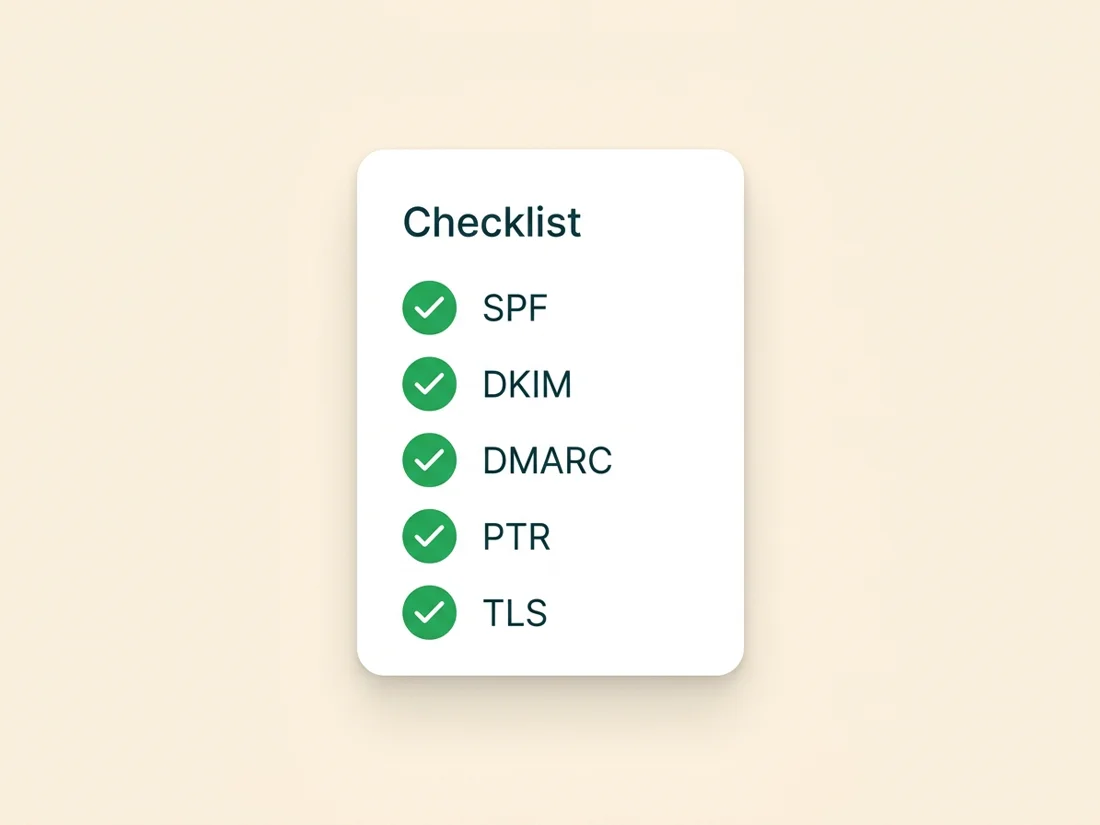
Two more infrastructure checks ride alongside the big three. You need valid PTR / reverse DNS (forward-confirmed reverse DNS) on your sending IPs, so a lookup on the IP resolves back to the hostname it claims, and you need TLS on the connection so mail is encrypted in transit. Both are now expected, not optional.
The rate thresholds you must hold
Passing authentication earns you a seat at the table. Staying at the table depends on behavioral thresholds, the numbers providers watch continuously to decide whether your mail is wanted. These are the bulk sender requirements that actually decide your fate day to day.
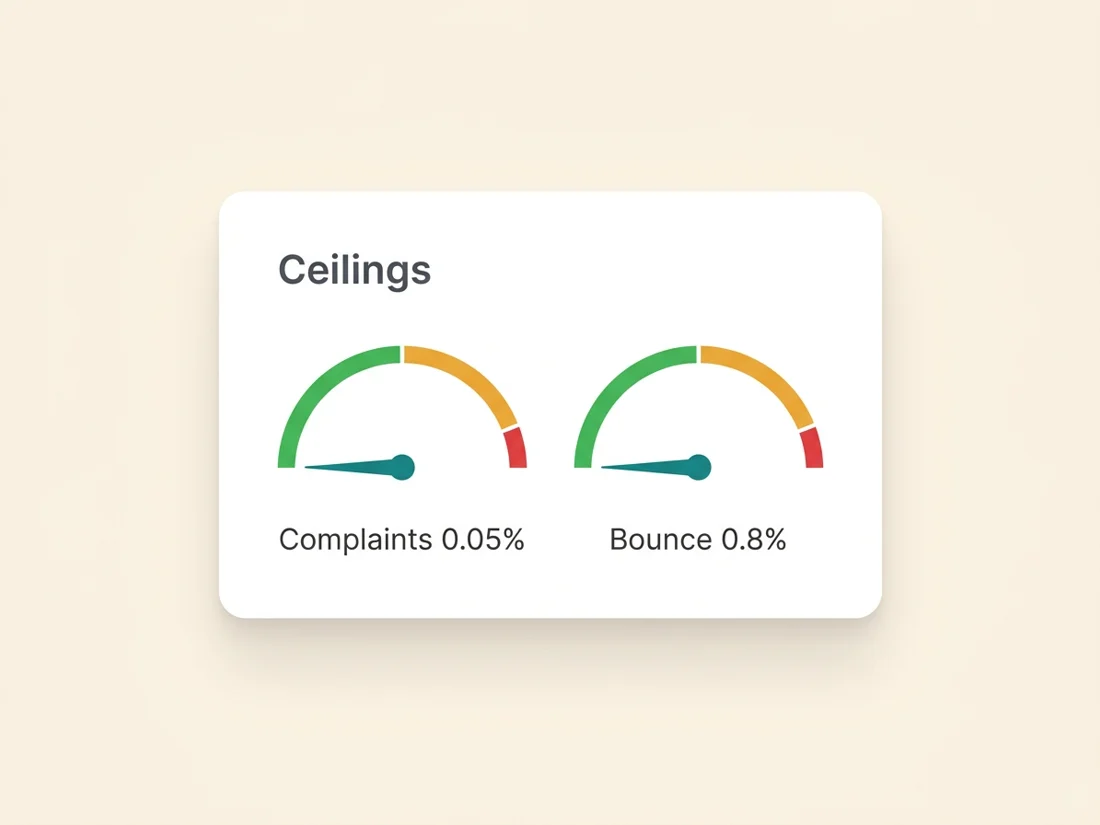
- Spam complaint rate under 0.3%. This is the single most important number in the whole framework. Google states plainly that you must keep your reported spam rate below 0.3%, and you should never approach it. Cross that line and filtering kicks in within days. The practical target is under 0.1%: hold there and you have real headroom; drift toward 0.3% and you are one bad campaign from the spam folder.
- Bounce rate under 2%. A high bounce rate is the clearest possible signal that you are mailing a list you did not verify, and a sender who does not vet recipients is exactly the profile providers throttle. Verify every address before it touches your reputation and this number stays near zero.
- Authentication passing on every message. The thresholds above only count if your mail authenticates. A complaint on unauthenticated mail is far more damaging than the same complaint on aligned, signed mail.
Here is the trap: the spam complaint rate is measured over a rolling window, so a single aggressive send to a poorly targeted list can spike it and haunt you for a week. You cannot fix it retroactively; you can only avoid crossing it. That is why compliance at scale is fundamentally about pacing and monitoring, not a one-time setup, and why Gmail in particular now weighs engagement and reputation signals that go well beyond the raw thresholds. We break those down in Gmail's 2026 filtering changes.
One-click unsubscribe and consent
The third pillar is the easiest to implement and the most commonly botched. Bulk senders must offer one-click unsubscribe that conforms to RFC 8058, which means a proper List-Unsubscribe header paired with List-Unsubscribe-Post, so the recipient's mail client can show a native unsubscribe button and a single click removes them with no landing page, no login, and no confirmation maze. And you must honor it fast: the guidance is to process unsubscribe requests within two days.
Why does the provider care so much about the unsubscribe experience? Because friction there converts directly into complaints, and complaints are the one metric you genuinely cannot afford. When someone wants out and cannot find the exit, they hit the spam button instead, and that single action costs you far more reputation than the lost recipient ever would. A clean one-click unsubscribe is not a courtesy; it is a complaint-rate safety valve.
Consent and content rules round this out. Under CAN-SPAM and its international cousins, every message needs a truthful From line, a non-deceptive subject, and a valid physical postal address in the footer. For cold email specifically, the discipline is tight targeting: a relevant reason to reach out to a genuinely relevant recipient keeps complaints low at the source, which is the real way you stay under the thresholds rather than fighting them after the fact.
The cold email compliance 2026 checklist
Here is the whole thing in one place. If you can tick every box below, you have cleared the entry bar for cold email compliance 2026 across Google, Yahoo, and Microsoft.
- SPF published and passing for every sending domain.
- DKIM signing on every message, with a valid published public key.
- DMARC published with alignment on the visible From domain, moving to enforcement once reports are clean.
- Valid PTR / reverse DNS on sending IPs (forward-confirmed).
- TLS on the sending connection.
- Spam complaint rate under 0.3%, targeting under 0.1%.
- Bounce rate under 2%, trending to near-zero on a verified list.
- One-click unsubscribe (RFC 8058,
List-Unsubscribe-Post) honored within two days. - Valid physical postal address and a truthful From line and subject in every message.
- Separate sending domains kept off your primary brand domain, verified before first send.
Notice that none of these are copywriting tips. They are infrastructure and discipline, and every one is measurable. That is exactly why the entire checklist can be automated, which is the point of the next section.
How SpamCipher keeps you compliant automatically
Reading a checklist is one thing. Holding it across dozens of mailboxes, at volume, week after week, is another, and that is the part almost nobody does well by hand. SpamCipher is built so the entire compliance framework runs itself.
Authentication is auto-published. For a domain on Cloudflare, you paste a DNS-edit token once and SpamCipher's DNS write adapter publishes the full SPF, DKIM, DMARC, and MTA-STS record set for you, generates a dedicated DKIM keypair per domain, then runs a verify loop and shows you a green badge for each record. Non-Cloudflare zones get the exact records to copy plus the same verify loop. You do not hand-craft DNS or guess at alignment; the platform gets it right and confirms it. Our Compliance Monitoring then keeps watching authentication and blacklists so a silent break surfaces immediately.
The rate thresholds defend themselves. Pre-send verification cleans every address before it can spike your bounce rate. Then a per-mailbox abuse monitor watches bounce rate per mailbox and complaint and unsubscribe rate per company over a rolling seven-day window, and enforces graduated action automatically: it warns, then throttles a mailbox's daily cap, then pauses it, all with hysteresis and auto-recovery so a brief blip does not overreact. If a complaint spike looks systemic, it throttles the whole tenant. In plain terms, the platform keeps your spam complaint rate and bounce rate under the enforced line by acting before the number crosses it, not after the damage is done.
One-click unsubscribe is handled end to end. Every message ships with the correct List-Unsubscribe and List-Unsubscribe-Post headers and a hosted one-click endpoint, so a single click suppresses the recipient instantly and permanently across every campaign. The CAN-SPAM footer and physical-address requirement are enforced at the template level, and a launch gate blocks any campaign that is missing them. There is a KYC gate at signup too, so the sending network stays clean and your domains sit next to responsible senders, not spammers.
That is the whole compliance framework, published, monitored, and defended by one system that owns authentication, verification, sending, and suppression as a single stack. It is also why SpamCipher can make a promise no bolt-on tool can: 90%+ inbox placement on unlimited, fully automated cold email. Compliance is the floor we build that promise on. If you want the deliverability deep-dive that sits on top of it, read how to own the inbox at 90%+ in 2026.
Stay compliant without the busywork
SpamCipher publishes your SPF, DKIM, and DMARC, monitors every compliance signal, and throttles risk before it crosses the line, so you send unlimited, fully automated cold email and still land 90%+ in the inbox. The whole framework, one platform.
Start sending compliant cold email