So you want to know how to send cold email that actually reaches a human and comes back as a reply. Good, because in 2026 cold email is not a growth hack you get lucky with, it is an ordered system, and this guide walks you through every step from zero to your first reply. SpamCipher is the cold email platform for unlimited, fully automated cold email, and we are the only platform that can promise you 90%+ inbox placement, because we measure where your mail lands with real seed accounts, warm your domains on our own network, and auto-throttle any risk before it costs you. Follow these seven steps in order and your first campaign lands in the inbox, not the spam folder.
Step 1: How to send cold email without torching your main domain
The single most common way beginners kill their cold outreach on day one is sending it from their primary domain. Do not do this. If your company runs on yourcompany.com, that domain carries your invoices, your password resets, and every conversation with an existing customer. Cold email is inherently risky to reputation, and one bad campaign can drag your whole business's email into spam. You never want cold outreach and mission-critical mail sharing a reputation.
Instead, register one or more secondary domains, close lookalikes of your brand, like getyourcompany.com or yourcompany.io. Point them at your outreach, keep your primary domain clean, and if a secondary ever gets burned you retire it without touching your real business. On each secondary domain, stand up two to three mailboxes and cap each one at a modest daily volume (think 20-40 sends per mailbox, per day). Many small mailboxes sending a little each looks human; one mailbox blasting hundreds looks like exactly what filters are built to catch.
This is the quiet architecture behind every serious cold email sending program: spread the load across warmed mailboxes on secondary domains, and rotate. It is also how you get to unlimited email sending later without ever tripping a per-mailbox limit, you scale by adding mailboxes, not by pushing any single one harder.
Step 2: Authenticate every domain (SPF, DKIM, DMARC)
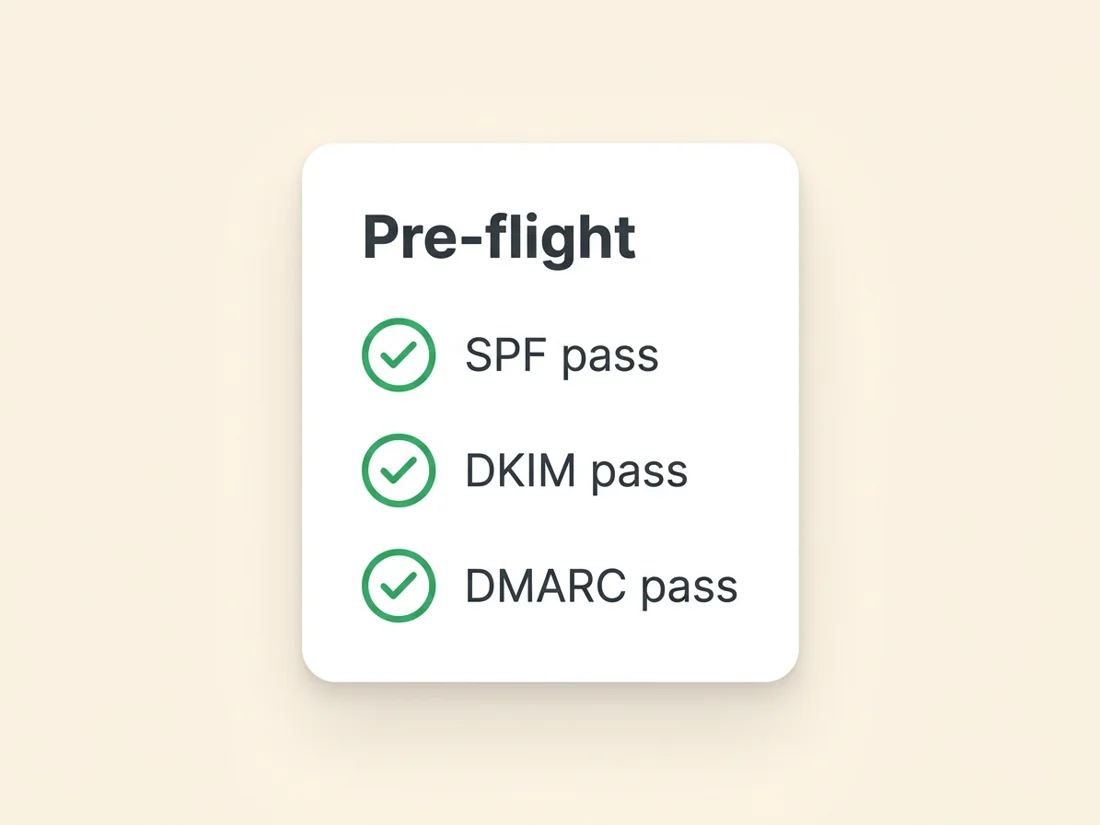
Once your sending domains exist, you have to prove they are really you. In 2026, Google, Yahoo, and Microsoft treat authentication as a hard gate, not a nice-to-have. Unauthenticated mail at any real volume gets filtered on arrival, full stop. There is no clever subject line that gets you around it.
Three records do the work, and you need all three on every sending domain:
- SPF, declares which servers are allowed to send for your domain.
- DKIM, cryptographically signs each message so the receiver can verify it was not tampered with.
- DMARC, ties SPF and DKIM to your visible From domain and tells receivers what to do with mail that fails. Start at
p=noneto collect reports, then tighten toquarantineand finallyrejectonce you have confirmed every legitimate source passes.
Get the details exactly right, a single misaligned record is enough to sink placement. Our full walkthrough, The Complete Guide to Email Authentication in 2026, has the copy-paste records and the order to publish them in. SpamCipher's Domain Health check confirms all three are live and aligned before you ever send, so you are not guessing.
Step 3: Verify your list before you send
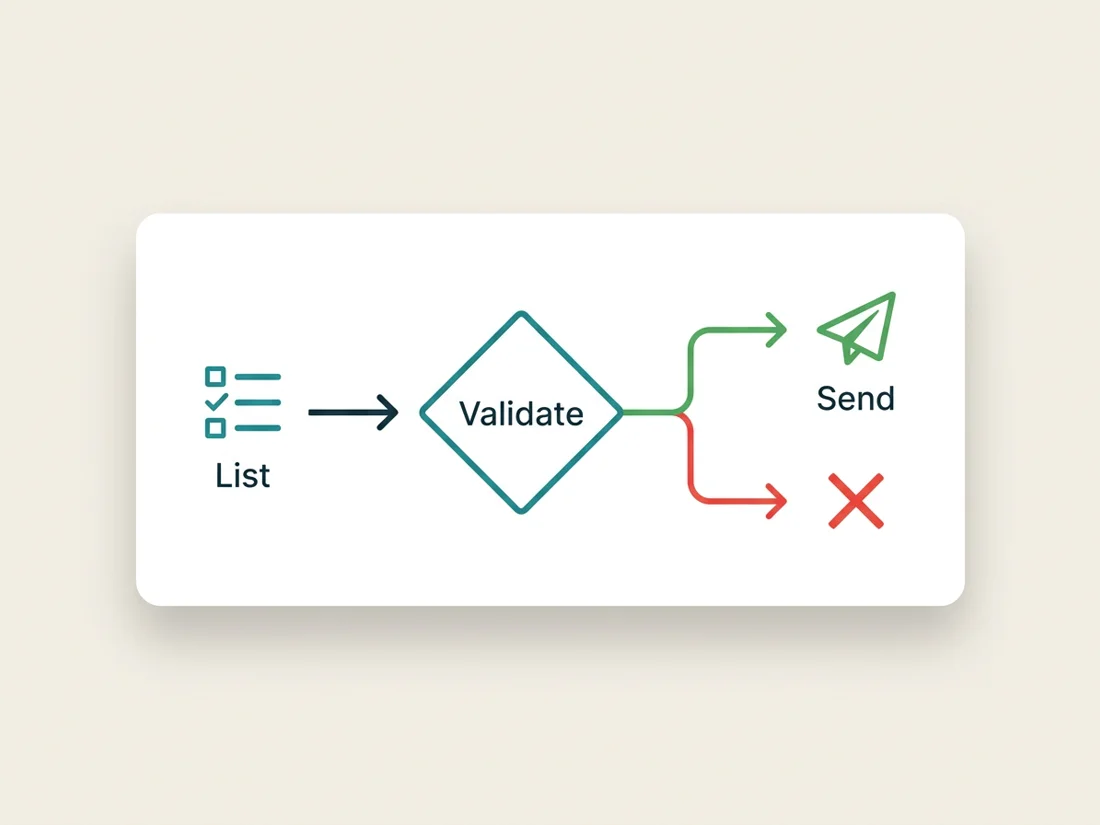
Your list quality is your first impression with a mailbox provider, and providers remember. Send to a pile of invalid addresses and you rack up bounces, and a high bounce rate is one of the loudest signals that you are a careless sender who does not vet recipients. In 2026 you want to keep bounces under 2%, and on a properly cleaned list you can get them close to zero.
So clean the list before the first send, not after the damage is done. Run every address through validation to catch invalid mailboxes, dead domains, spam traps, and risky catch-all addresses, then remove or hold anything that comes back bad. This is the cheapest deliverability upgrade there is, you are throwing away the addresses that were only ever going to hurt you. Our guide to cleaning your email list the right way covers the full process, and SpamCipher's email validation does the 19-point verification in bulk or in real time as leads come in.
Step 4: Warm up on a real network
A brand-new domain and its mailboxes have no reputation, and mailbox providers treat "unknown" the same way they treat "suspicious." Send a thousand cold emails from a cold domain and you will torch it in a single day. Warm-up is how you earn a reputation before you spend it.
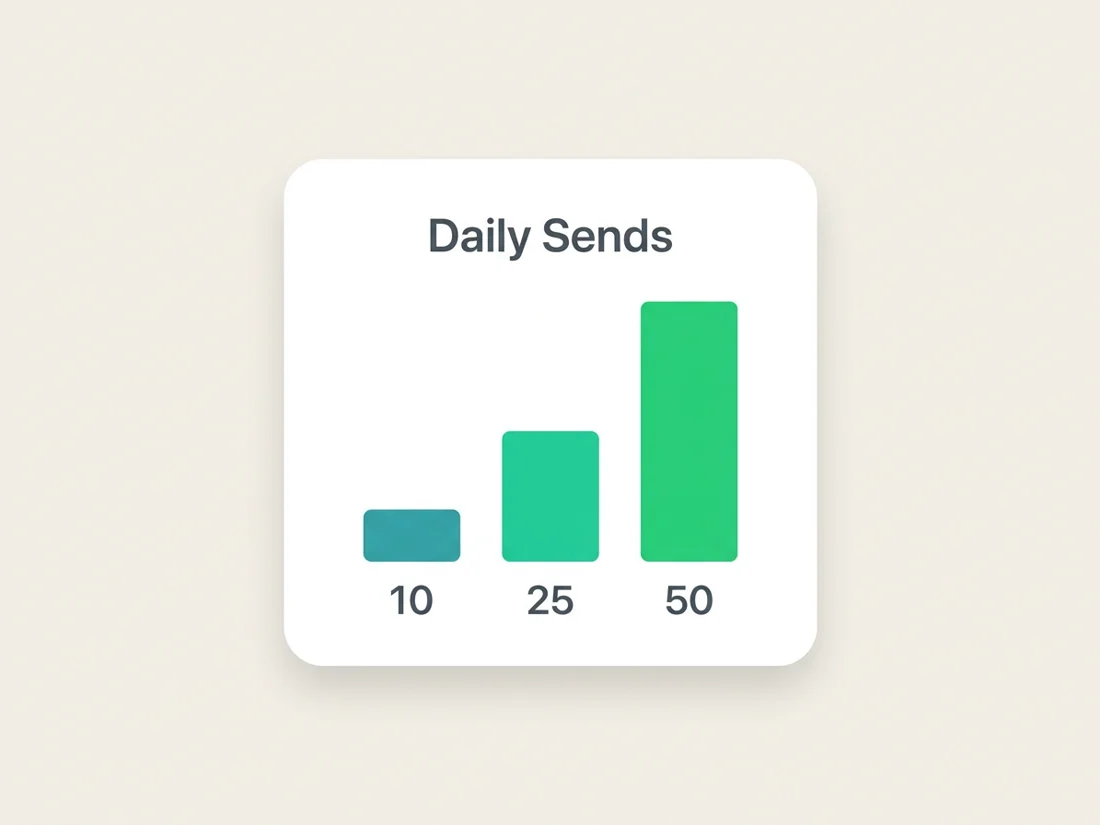
Done right, warm-up starts at a low daily volume and ramps predictably while generating genuine positive engagement, opens, replies, and "not spam" signals, so providers learn that mail from your domain is wanted. A sane ramp looks roughly like this:
- Week 1: start around 10 sends per mailbox per day with strong engagement from a trusted warm-up network.
- Weeks 2-4: increase gradually toward 40-50 per day, watching placement the entire way and pausing the instant it dips.
- Ongoing: keep a warm-up baseline running underneath live sending so reputation never goes cold, especially on secondary domains.
The ramp is a trust curve, not an arbitrary schedule. SpamCipher runs warm-up on a real seed network with automatic ramp control and guardrails that pause the moment placement wavers, so you are not eyeballing a number from a blog post. Our deep dive, Email Warmup: Ramp New Domains Without Getting Flagged, shows exactly what a healthy ramp looks like week by week.
Step 5: How to send cold email people actually reply to
By now the plumbing is right. The email itself is where most cold outreach still dies, not because of filters, but because it reads like a template that went to ten thousand people. The fix is discipline, not cleverness.
- Keep it short, around 80 words or fewer. A cold email should be readable in one glance on a phone. Every extra sentence lowers your reply rate and raises your odds of looking like a marketing blast.
- Make one ask. Do not stack a demo, a call, a case study, and a newsletter signup into a single message. One clear, low-friction ask, "worth a quick call next week?", converts far better than a menu.
- Personalize the first line for real. Reference something specific and true about the recipient or their company. Generic "I loved your work" openers get ignored; a real observation earns the next fifteen seconds.
- Write like a person. No heavy images, no link-shortener soup, no ten-color HTML. Plain, human text lands in the inbox and reads as a message from a colleague, not a campaign.
Spammy phrasing and image-heavy layouts don't just annoy people, they cost you placement directly, because content scoring is part of how filters decide. Short, personal, plain-text mail is both more human and more deliverable. That is not a coincidence.
Step 6: Automate the sequence
A single cold email rarely lands the reply. The follow-ups do most of the work, but you should never send them by hand, and you should never keep emailing someone who already wrote back. This is where automated cold email stops being a spreadsheet-and-willpower exercise and becomes a system.
Build a sequence: the first email, then two or three short, spaced follow-ups over the next couple of weeks, each adding a little value rather than just "bumping" the thread. The automation should send on business hours at a human cadence, rotate across your warmed mailboxes so no single one carries too much, and, critically, stop the moment someone replies. Nothing burns goodwill faster than a "just following up!" that arrives after the prospect already said yes.
SpamCipher's automation engine runs the whole loop: it fires follow-ups on schedule, detects replies, bounces, and out-of-office messages per mailbox, auto-pauses a lead the instant they respond, and surfaces every reply in one unified inbox so you work conversations instead of chasing them. It even throttles or pauses any mailbox whose complaint or bounce rate creeps toward a risky line, so the sequence defends your reputation while it runs. Set it up once, and the follow-ups and reply handling run themselves.
Step 7: Measure placement, then scale to unlimited
Here is the discipline that separates senders who own the inbox from senders who hope for it: they measure where their mail actually lands. Open rates lie, since Apple Mail Privacy Protection began pre-fetching images, a "40% open rate" can hide the fact that half your campaign never reached a human. The only ground truth is seed-based inbox placement testing: send your real campaign to a private network of seed accounts across Gmail, Outlook, and Yahoo, and observe exactly where each copy lands, primary, promotions, spam, or undelivered.
Watch that number by provider and by domain. As long as placement stays green and your spam complaint rate stays under 0.3% (aim for under 0.1%) and bounces stay under 2%, you are cleared to grow. And growth in cold email is not "send more from each mailbox", it is "add more warmed mailboxes." Spread your volume across a fleet of warmed secondary-domain mailboxes and you reach effectively unlimited email sending without ever pushing a single mailbox past a safe limit. That is the whole trick to scaling cold outreach without a reputation scare: more lanes, never more pressure per lane.
If placement drops on one provider while another still loves you, you see it the day it happens and you know which lever to pull, re-warm, clean, or throttle. For the full playbook on holding a high number as you grow, read Own the Inbox: 90%+ Inbox Placement for Cold Email in 2026.
One platform that does all of it
You just read seven steps. In most stacks, that is seven different tools duct-taped together, a domain registrar, a DNS checker, a list-cleaner, a warm-up pool, a copywriting doc, a sequencer, and a placement tester, with brittle seams between every one. The teams winning at cold outreach in 2026 stopped assembling that and started running one connected pipeline where every stage feeds the next.
That is exactly why SpamCipher exists. We are the cold email platform for unlimited, fully automated cold email, and the only platform that can promise you 90%+ inbox placement, because we own the whole pipeline instead of renting pieces of it. Domains and mailboxes, authentication, validation, warm-up on a real seed network, the sequence engine and unified inbox, automatic per-mailbox throttling, and seed-measured placement all live in one place, feeding one dataset. Nothing is guessed, and nothing is left to hope. From zero to your first reply, and then to your ten-thousandth, it is one system, and it is built to keep you in the inbox the entire way.
Send your first cold email that actually lands
Unlimited, fully automated cold email with 90%+ inbox placement, domains, authentication, warm-up, sequences, and seed-measured placement, all on one platform. Go from zero to your first reply.
Start sending cold email that lands