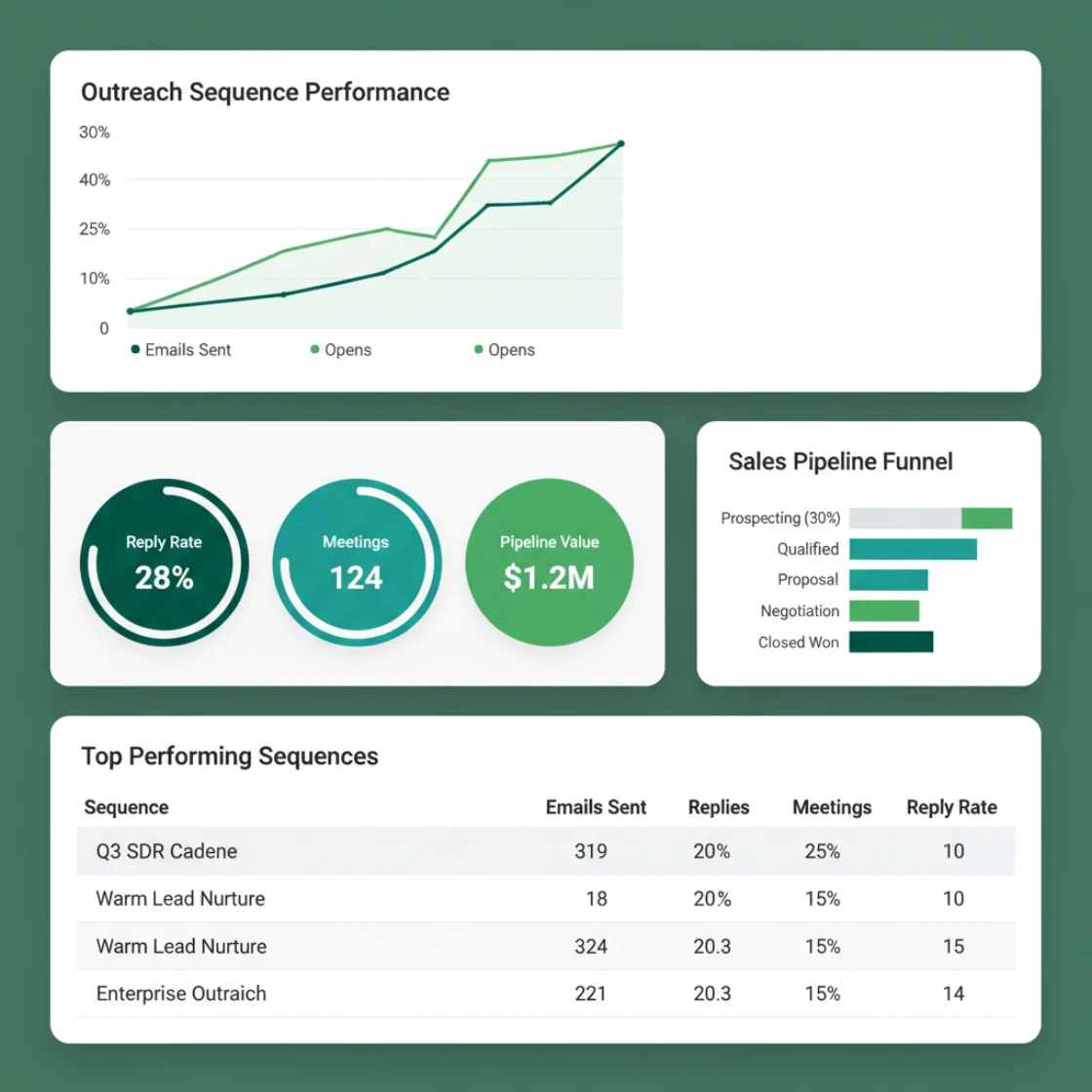
Your cold email platform shows 40% open rates but your replies dried up three weeks ago. The dashboard looks healthy. The pipeline is not. This is the gap between vanity metrics and the infrastructure-level signals that predict whether your next thousand sends will land, or quietly disappear into spam folders you cannot see.
Most cold email analytics are built for hobbyists. They count opens and clicks and pretend that tells you something about deliverability. For an agency running forty client domains or a growth team pushing six figures of monthly sends, that fiction collapses fast. The numbers that actually matter, the ones that predict whether your next campaign lives or dies, live in infrastructure: authentication health, reputation trajectory, placement patterns across mailbox providers, and the silent signals receivers send back before they ever file a spam complaint. This is what advanced reporting means when volume is the constraint.
Why Standard Metrics Fail at Volume
Open rates are not false. They are incomplete. A 45% open rate on a thousand sends to warmed personal inboxes tells you almost nothing about what happens when you scale to fifty thousand sends across twelve client domains with mixed reputation histories.
The standard dashboard tracks symptoms. Fever, not infection. What it misses:
- Authentication drift. SPF, DKIM, and DMARC records degrade. Subdomains are added without policy alignment. Marketing teams rotate tools and append new includes to DNS records. The SPF lookup limit, hard-coded at 10 DNS mechanisms per RFC 7208, is exceeded silently. Authentication that passed last quarter now returns permerror on every message, and your open rate is still 38% because the remaining volume is landing in spam folders your tracking pixel never reaches.
- Reputation segmentation. Gmail, Outlook, and corporate filters score sending IP and domain reputation separately. A single aggregate "deliverability score" flattens this into uselessness. You need per-provider placement, per-domain reputation trajectory, and the ability to see when a specific mailbox provider starts throttling before the throttling becomes a wall.
- Warm-up state. Cold mailboxes added to rotation without proper seed network warm-up start with neutral or negative reputation. Standard analytics treat them identically to established senders. The result is a blended average that hides collapsing performance on the new volume you are most eager to scale.
The fix is not more charts. It is telemetry that connects sending infrastructure to placement outcomes, reported at the granularity where decisions actually happen: per domain, per mailbox provider, per sending identity.
What Advanced Reporting Actually Measures
Advanced analytics for high-volume cold email rests on four pillars. Each connects a technical input to a business outcome in a way that lets you intervene before damage compounds.
Infrastructure Health Monitoring
This is not a green checkmark. It is continuous validation of the records that authenticate your sending identity, with failure alerts and historical trending. The specific checks that matter:
- SPF record validity and lookup count (the 10-mechanism limit is cumulative across nested includes, not visible in the record text)
- DKIM signature presence and key rotation status
- DMARC policy enforcement level (p=none is reporting-only; p=quarantine or p=reject is actual protection, and most domains never progress past none)
- DNS blocklist presence across major RBLs
Authentication proves identity. It does not buy placement. A domain can pass all three checks and still be filtered on reputation grounds. The value of infrastructure monitoring is that it eliminates the obvious failure modes so you can focus on the harder problem of reputation and engagement.
Placement and Reputation Telemetry
Inbox placement testing uses seed accounts across mailbox providers to measure where messages actually land: primary inbox, promotions tab, spam folder, or rejected at the edge. This is distinct from delivery (accepted by the receiving server) and from open rates (which depend on inbox placement plus subject line plus send time).
Reputation monitoring tracks sending IP and domain scores at major providers, with velocity limits and throttling indicators. The signal you need is not a number but a trajectory: reputation degrading at Outlook while holding steady at Gmail tells you exactly where to focus remediation.
Send Flow and Rotation Analytics
For agencies managing multiple client domains, the critical metric is utilization and exhaustion across sending identities. Which mailboxes are approaching daily or hourly velocity limits? Which domains show declining placement and should be rotated out of active sends? Which sequences are generating reply patterns that signal engagement versus automated filtering?
This requires per-mailbox send counts, per-domain placement rates, and sequence-level reply classification, all visible in a single view that maps to how you actually operate: by client, by campaign, by sending identity pool.
Verification and List Quality Feedback
Email verification is typically a pre-send batch process. Advanced reporting integrates verification into the send flow with real-time feedback: catch-all detection, role account flagging, and bounce pattern analysis that identifies list decay before it damages reputation. The metric that matters is not "verified emails" but "verified emails that actually engage," tracked per source and per acquisition channel.
The Architecture Problem: Bolted-On vs. Owned Pipeline
Most cold email platforms approach analytics as a reporting layer on top of sending infrastructure they do not control. The sending happens through third-party SMTP relays or connected mailboxes. Warm-up is a separate service with its own dashboard. Verification is another vendor. Placement testing is a manual export to a standalone tool.
This architecture produces data fragmentation. Your open rates live in the sending platform. Your reputation scores live in a monitoring service. Your authentication status lives in a DNS checker. Your warm-up metrics live in a warm-up tool. No single view connects a DMARC policy change to a placement shift three days later, because the data lives in different products with different time granularities and no shared identity.
The operational cost is decision latency. You notice a placement problem when replies drop, which lags the actual reputation damage by days or weeks. You trace it to a DNS change made by a client marketing team you never knew about. You fix it, but the recovery period is measured in warm-up cycles, not hours.
The alternative is an owned deliverability pipeline: send, warm, verify, place, and report on infrastructure built for the purpose, with unified identity across every stage. This is not a feature list difference. It is a structural difference in what you can see and how fast you can act.
Worked Scenario: Agency Scale and the Visibility Gap
Suppose you run an agency managing cold email for twelve clients. Each client has three to five sending domains, and you are ramping total monthly volume from 80,000 sends toward 300,000 as you onboard new accounts.
Your current stack: a sending platform with metered tiers, per-mailbox add-ons for additional sending identities, and a separate warm-up service you pay per mailbox. Analytics are standard: opens, clicks, replies, bounces, with a deliverability score aggregated across all sending.
Week six of your ramp, three clients report reply volume down 60% from prior weeks. Your aggregate dashboard shows open rates of 34%, down from 41%. You investigate.
The problem: two client domains had DMARC records at p=none (reporting only, no enforcement). A marketing contractor added a new email service to one domain without updating SPF, exceeding the 10-lookup limit. The SPF permerror caused authentication failures that degraded domain reputation at Outlook specifically. Because your analytics aggregate across providers, you saw a modest open rate decline, not a catastrophic placement collapse at one major mailbox provider.
The warm-up service, running separately, had no visibility into the authentication failure. It continued warming mailboxes that were now being filtered. The verification service had cleared the lists pre-send, so bounces were low. The failure mode was invisible to every tool except the one you were not using: continuous infrastructure monitoring with per-provider placement testing.
Recovery required: identifying the SPF failure, flattening the record to reduce lookups, requesting reputation reconsideration at Outlook (a 2-4 week process), and rebuilding warm-up on new clean mailboxes. Client relationships strained. The client with the SPF failure considered terminating.
The structural fix: infrastructure monitoring that flags SPF lookup count before it fails, DMARC policy that actually enforces (p=quarantine minimum), per-provider placement visibility that surfaces Outlook collapse while Gmail holds steady, and warm-up integrated with authentication health so you are not warming mailboxes that cannot land.
This scenario is illustrative, not exceptional. The pattern, authentication degradation under scale pressure, is repeatable across any agency growth curve.
Actionable Reporting Setup for High-Volume Senders
If you are evaluating platforms or rebuilding your analytics stack, prioritize these capabilities in this order.
First: Infrastructure visibility with enforcement checking. You need SPF, DKIM, and DMARC monitoring that reports policy level explicitly (distinguishing p=none from p=quarantine/reject) and counts actual DNS lookups against the 10-mechanism limit. Alerts should fire on record change, not just failure, because change precedes failure.
Second: Per-provider placement testing. Aggregate deliverability scores are useless. You need seed-based inbox placement data for Gmail, Outlook, Yahoo, and major corporate filters (Proofpoint, Mimecast, Barracuda), reported per domain and per sending identity, with daily or better frequency during ramps.
Third: Unified send and reputation telemetry. The same dashboard should show send volume, authentication status, placement rates, and reputation indicators per domain, with time-aligned views that let you correlate a DNS change on Tuesday to a placement shift on Thursday.
Fourth: Warm-up state integration. Mailboxes in warm-up should be visually distinct from production senders, with their own placement tracking and automatic promotion to active rotation only when placement thresholds are met. Manual warm-up management at scale is error-prone and slow.
Fifth: Reply classification and sequence analytics. Not just reply rate, but reply sentiment (interested, neutral, unsubscribe request, automated response) and sequence-level performance that identifies which touch patterns generate engagement versus filtering.
Platforms that deliver this typically share one architectural trait: they own the full pipeline rather than aggregating third-party services. The integration cost of bolted-on tools, measured in decision latency and missed signals, exceeds the apparent savings for any sender above modest volume.
For a deeper look at how agencies structure reporting across multiple client accounts, see Agency Cold Email Reporting and Analytics at Scale.
SpamCipher: Analytics as Infrastructure
SpamCipher is the cold email platform for unlimited, automated, high-volume sending, built for agencies and growth teams. It delivers advanced analytics not as a reporting module but as instrumentation of an owned deliverability pipeline: send, warm, verify, place, and monitor on infrastructure built for the purpose.
The analytics layer in SpamCipher connects every stage. Infrastructure monitoring tracks SPF lookup counts, DKIM key rotation, and DMARC policy enforcement with alerts on change. Placement testing runs continuously across a seed network covering major mailbox providers, reported per domain and per sending identity. Warm-up state is visible and gated: mailboxes graduate to active rotation based on placement thresholds, not calendar time. Send flow analytics map utilization across your identity pool with exhaustion warnings and automatic rotation.
This matters operationally because the signals you need to protect volume are generated and consumed in the same system. A DMARC policy change is visible immediately. An SPF record approaching the lookup limit triggers alert before permerror. Placement degradation at a specific provider surfaces in daily reporting, not in reply volume collapse two weeks later.
SpamCipher stands behind its own 90%+ inbox placement claim, backed by the owned pipeline that generates the telemetry to measure it. The platform starts free and scales to unlimited sending without per-email metering, because the constraint on growth should be your market and your operations, not your software bill.
For senders evaluating how reputation monitoring fits into a complete outbound system, Cold Email Platform with Advanced Reputation Monitoring: What Actually Works covers the technical standards in depth.
Platform Comparison: What to Ask Vendors
| Capability | What to Verify | Why It Matters |
|---|---|---|
| Infrastructure Monitoring | Does it track SPF lookup count, not just record presence? Does it distinguish DMARC p=none from enforcing policies? | Prevents authentication failures that aggregate metrics hide |
| Placement Testing | Is it seed-based across Gmail, Outlook, Yahoo, and corporate filters? Is it per-domain or aggregate? | Per-provider visibility is required to target remediation |
| Warm-up Integration | Is warm-up on the same infrastructure as production sends? Is placement data used to gate rotation? | Separate warm-up services lack visibility into production reputation |
| Send Flow Analytics | Can you view utilization per sending identity with velocity and exhaustion tracking? | Agency scale requires identity-level operational visibility |
| Reply Classification | Are replies categorized by intent, or just counted? | Sequence optimization requires sentiment, not volume |
| Data Architecture | Is the pipeline owned or aggregated from third parties? | Unified identity across stages enables causal analysis |
Most platforms will answer positively to simplified versions of these questions. Push for specificity. "We monitor deliverability" is not the same as "we count SPF lookups and test placement per provider daily." The difference determines whether your analytics will surface problems in time to fix them.
Implementation Priorities for Existing Stacks
If you are not replacing your platform immediately, you can improve analytics visibility with targeted additions.
Immediate: Audit authentication records. Use a tool that counts SPF lookups including nested includes. Check DMARC policy level on every sending domain. Set calendar reminders for quarterly re-audit, or automate alerts on DNS change.
Short-term: Add per-provider placement testing. Manual seed testing is better than aggregate scores. Run weekly tests during ramps, daily if you are changing infrastructure. Track trend, not single points.
Medium-term: Integrate warm-up and production visibility. If you use separate warm-up, manually correlate warm-up mailbox performance with production domain reputation. Look for divergence that suggests the warm-up network does not match your actual sending pattern.
Ongoing: Build reply classification. Even manual tagging of replies by intent (interested, neutral, negative, automated) improves sequence analysis dramatically. Automate when volume justifies.
The goal is progressive reduction in decision latency: the time between a problem occurring and your ability to identify, locate, and remediate it. Each integration step tightens this loop.
Frequently asked questions
See where your domain stands
Run the free SpamCipher check and see exactly which authentication and reputation gaps apply to your sending domain.
Get started free