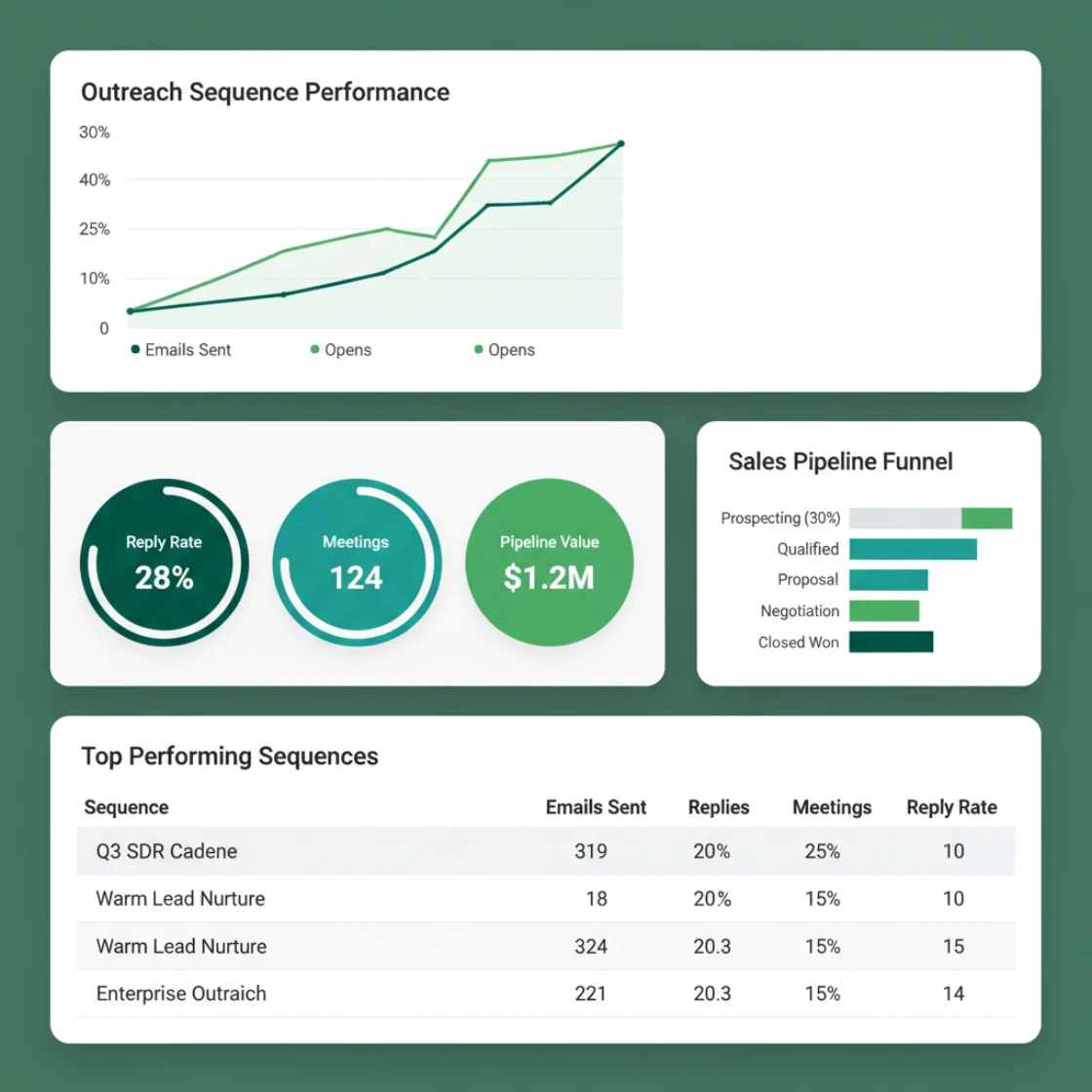
A sales engagement platform does two things at once: it combines every method of outreach into one system, and it centralizes the reporting and performance analytics that tell you whether that outreach is working. Most teams assemble that from four tools that do not talk to each other, a sequencer to send, a shared inbox to catch replies, a CRM to store the record, and a spreadsheet to reconcile the numbers. SpamCipher is built to be the one system instead. It sequences the touches, sends them at scale, captures every reply in a unified inbox, records the relationship in a built-in CRM, and reports on the whole thing from a single place, on top of a deliverability pipeline that makes those numbers real. This is what sales engagement looks like when it is one product rather than five subscriptions.
What a sales engagement platform actually is
Strip the category down to its definition and it is simple. A sales engagement platform lets a team work more efficiently by combining all methods of outreach into one system and centralizing reporting and performance analytics. Everything else, the sequences, the inbox, the CRM, the dashboards, is how a product delivers on those two promises.
The first promise is about the workflow. Outbound is not one action, it is a chain: build the audience, sequence the messages, send them across your mailboxes, catch what comes back, and route each reply to the right next step. When each link lives in a different tool, the team becomes the integration layer, copying lists between apps, reconciling who has been contacted, and losing the thread the moment a lead replies from an address the sequencer never saw. Combining outreach into one system removes that friction, because every touch, from first send to booked meeting, moves through the same automated pipeline.
The second promise is about measurement. Outreach only improves if you can see what is working, and you can only see that if the numbers live in one place. A sales engagement platform centralizes the metrics that matter, sends, opens, replies, positive replies, meetings, and opportunities, so a manager can answer "which sequence is booking meetings and which is burning list" without exporting three CSVs and joining them by hand. SpamCipher delivers both promises for outbound email, and the rest of this piece walks through how.
Every touch in one system: sequences and cadences
Engagement starts with the sequence, and with the message inside it: the machinery only amplifies the craft of writing a sales email a decision-maker actually reads. In SpamCipher, a sequence is not a fixed three-email drip, it is a cadence you build on a canvas: a trigger enrolls a lead, then steps, waits, and branches carry that lead through the outreach. A Condition node splits the path on any field. A Switch routes leads into named cases. A Wait-for-event node parks a lead until something specific happens, a reply, a click, a bounce, then resumes the instant it does. That is the difference between a cadence that adapts to each prospect and a blast that treats everyone the same.
Because sequences are bound to Living Segments, saved queries over your CRM and lead corpus, enrollment maintains itself. A lead enters the moment it starts matching "VP or above, SaaS, verified work email, no reply in 30 days" and exits the moment it stops. The team is not loading static lists into campaigns every week; the audience is alive and the cadence follows it. Underneath, unlimited sending spreads the touches across your warmed mailboxes at safe pacing, so a growing program does not mean a growing pile of per-seat sender subscriptions. Every method of outreach, cold sequences, follow-ups, re-engagement, nurture, runs on the same engine.

One inbox for every reply
Sending is the easy half of engagement. The half that makes money is what happens when someone writes back, and it is where a stitched stack falls apart, because the reply lands in one of a dozen mailboxes while the record sits in a CRM that never sees it. SpamCipher pulls every reply, across every sending mailbox, into a single unified inbox. One place to read, triage, and respond, with the full conversation and the CRM record side by side, so a rep is never guessing which sequence a reply belongs to.
On top of that inbox sits the AI Reply Agent. When a lead replies, a hot-path trigger hands the thread to the agent, which reads the intent and acts across a whitelisted set of tools: on a positive reply it drafts a response, sets the contact to interested, creates an opportunity, and schedules a follow-up; on an objection it drafts a rebuttal; on an opt-out it suppresses the contact. Each of those is a real primitive in the same system, not a webhook to somewhere else, which is what lets engagement close the loop instead of just tagging a message. Routine replies get handled; the conversations that need a human are the only ones a human sees. The built-in CRM keeps the record of all of it, so contacts, statuses, and opportunities live in the same platform that did the outreach.

Centralized reporting and performance analytics
This is the half of the category most tools treat as an afterthought, and it is the half that separates a sales engagement platform from a glorified sender. Because every touch and every reply moves through one system, SpamCipher can report on the entire funnel from a single place, no exports, no manual joins, no reconciling five dashboards to answer one question.
The metrics that matter are centralized and broken down the way a sales team actually thinks about them:
- Activity: sends, opens, and clicks, per sequence, per campaign, per mailbox, and per segment.
- Engagement: reply rate and, more importantly, positive-reply rate, so you can tell interest apart from "please stop."
- Pipeline: meetings booked and opportunities created, tied back to the exact sequence and step that produced them, which is what makes cost per meeting a number you can actually compute.
- Health: bounce rate and complaint rate per mailbox, so a manager sees a program drifting toward trouble before it costs the domain.
Centralizing those numbers is what makes the platform a management tool and not just an execution tool. You can compare two subject lines by positive replies, retire the sequence with the best open rate but the worst meeting rate, and see which segment is carrying the pipeline, all in one view. That is the "centralizing reporting and performance analytics" half of the definition, delivered in practice rather than promised in a feature list.

Numbers you can trust: engagement on real placement
Here is the detail that most sales engagement tools cannot offer, because it requires owning the deliverability layer. Engagement analytics are only meaningful if the email actually arrived. A 2% reply rate measured against a campaign that half-landed in spam is not a real 2%, it is a number that quietly lies to you, and it sends teams rewriting copy to fix a problem that was never about the copy.
SpamCipher runs seed-based inbox-placement testing inside the same platform that does the sending, so its performance analytics are grounded in what reached a human, not just what left the server. When placement drops, the platform sees it and can throttle or rotate the affected mailbox before the damage spreads, and your reply rates stay honest because they are measured against mail that actually landed. That is the advantage of engagement and deliverability being one product: the reporting is not just centralized, it is true. We cover the mechanics of that measurement in seed-based inbox-placement testing, and the metrics themselves in reply rate benchmarks for 2026.
Why one system beats a stitched sales stack
Put the pieces together and the case for one system is straightforward. A sequencer, a separate inbox, a standalone CRM, and a reporting tool each work in isolation, but the value of sales engagement lives in the seams between them, and the seams are exactly what a stitched stack cannot hold. The sender does not know a reply came in. The inbox does not know which sequence it belongs to. The CRM does not know the mailbox is throttled. The reporting tool only knows what you remembered to export into it.
Combine those into one platform and the signals move instead of leaking: a reply stops the sequence, updates the CRM, and shows up in the report the moment it arrives, all without a human wiring it together. That is what SpamCipher means by a sales engagement platform, one system for outreach, replies, and reporting, on a pipeline that also owns deliverability so the whole thing lands and the numbers hold up. If you want the broader picture of running your outbound this way, the own your cold email pipeline piece makes the full argument, and the all-in-one platform page shows how the parts fit together.
Run outreach, replies, and reporting in one system
Sequences, a unified inbox, a built-in CRM, and centralized analytics on one platform, on a deliverability pipeline that makes the numbers real. Unlimited sending and mailboxes, no credit card required.
Start engaging for free