

Automated cold email is the dream every outreach team chases: sequences that send themselves, follow-ups that fire on cue, replies that get worked while you sleep. The problem is that most automation gets there by blasting on autopilot, complaints spike, bounces climb, and the domain quietly dies in spam. SpamCipher is built to end that trade-off. We are the cold email platform for unlimited, fully automated cold email, and we are the only platform that can promise you 90%+ inbox placement, because our automation runs on top of an owned deliverability pipeline that measures where your mail lands and auto-throttles any risk before it costs you a reply. This is how you put outreach on autopilot without torching the thing that makes it work.
What automated cold email should actually do
Most people hear "automated cold email" and picture a scheduler: load a list, write three messages, press go, and let the tool drip them out over a few days. That is the floor, not the ceiling. Scheduled sending is the easy 20% of automation, and it is also the part that gets people in trouble, because a scheduler with no awareness of what happens after send will happily keep firing into a domain that is already on fire.
Real automation does four things a scheduler cannot. It branches on behavior, so a lead who opens and clicks gets a different path than one who goes silent. It reacts to events, so a reply, a bounce, or an out-of-office changes what happens next in real time. It handles the reply, not just the send, reading intent and taking the next action instead of dumping everything back on a human. And it defends itself, watching its own deliverability and pulling back the instant a signal turns bad. SpamCipher calls this layer Automations (internally, Flows): a visual builder where triggers and actions span the entire product, from validation and warm-up to sending, CRM, and enrichment.
The difference matters because the value of automation is not sending faster. It is sending correctly at a scale no human can babysit. That only works when the automation can see and act on the same signals a careful operator would, which is exactly what a stitched-together stack of point tools cannot do.
Where cold email automation usually goes wrong
Here is the trap that kills most automated programs. You wire a sending tool to a separate warm-up service, a separate verifier, a Zapier flow, and a spreadsheet. Each piece works in isolation. But automation moves fast, and the seams between those tools are exactly where the awareness lives. The sender does not know the list was never verified. The warm-up tool does not know complaints just spiked. The Zapier flow does not know a mailbox is already throttled. So the automation keeps sending, at speed, straight off a cliff.
Cold email automation goes wrong in three predictable ways. First, volume outruns reputation: a sequence ramps faster than the domains were warmed for, and placement collapses. Second, a dirty list feeds the machine: unverified addresses drive the bounce rate up, and providers read a high bounce rate as a sender who does not vet recipients. Third, complaints go unnoticed: a subject line or an offer draws spam clicks, and because nothing is watching the complaint rate, the domain is already filtered by the time anyone looks. Automation does not cause these failures. It just makes them happen faster and at larger scale than a human ever could by hand.
The fix is not to automate less. It is to automate on a foundation that shares one dataset, so the sending layer knows what the deliverability layer knows. We made the full argument for that in own your cold email pipeline, and it is the whole reason SpamCipher owns validation, deliverability, sending, and CRM as one stack instead of asking you to bolt them together.
Sequences that branch on behavior
The heart of good automation is a sequence that adapts. In SpamCipher's builder you start from a trigger, a new lead entering a segment, a scheduled batch, an inbound webhook, and then chain actions on a canvas: send a step, wait, check a condition, branch. The waits are durable, so a follow-up that should fire three days later actually parks and resumes cleanly rather than living in a fragile timer.
What makes it a real sequence and not a drip is branching. A Condition node splits the path on any field, true down one branch, false down the other. A Switch routes a lead into named cases by a value, with an "any other" default catching the rest. A Wait-for-event node parks a lead until something specific happens, like a reply from that exact contact, then resumes the instant it does, with a timeout fallback if it never comes. So instead of one linear cadence, you build outreach that reads like a decision tree: replied means stop and hand to the reply agent, clicked twice means jump to a warmer follow-up, bounced means suppress and exit, silent after three touches means drop into a long-term nurture.
Because these flows are bound to Living Segments, saved queries over your CRM and the lead corpus, enrollment maintains itself. A lead auto-enters a flow the moment it starts matching "VP or above, SaaS, verified work email, no reply in 30 days," and auto-exits the moment it stops. You are not manually loading lists into campaigns. The audience is alive, and the sequence follows it. That is the behavior node-only tools lack, and it is what turns cold email sequences from a one-shot blast into a system that works your pipeline continuously.
Replies on autopilot: the AI Reply Agent
Sending is the easy half. The hard half, the half that actually makes money, is what happens when someone writes back. This is where most automation stops and dumps everything into a shared inbox for a human to triage. SpamCipher keeps going. The AI Reply Agent is an agentic node that does not just classify a reply, it handles it end to end.
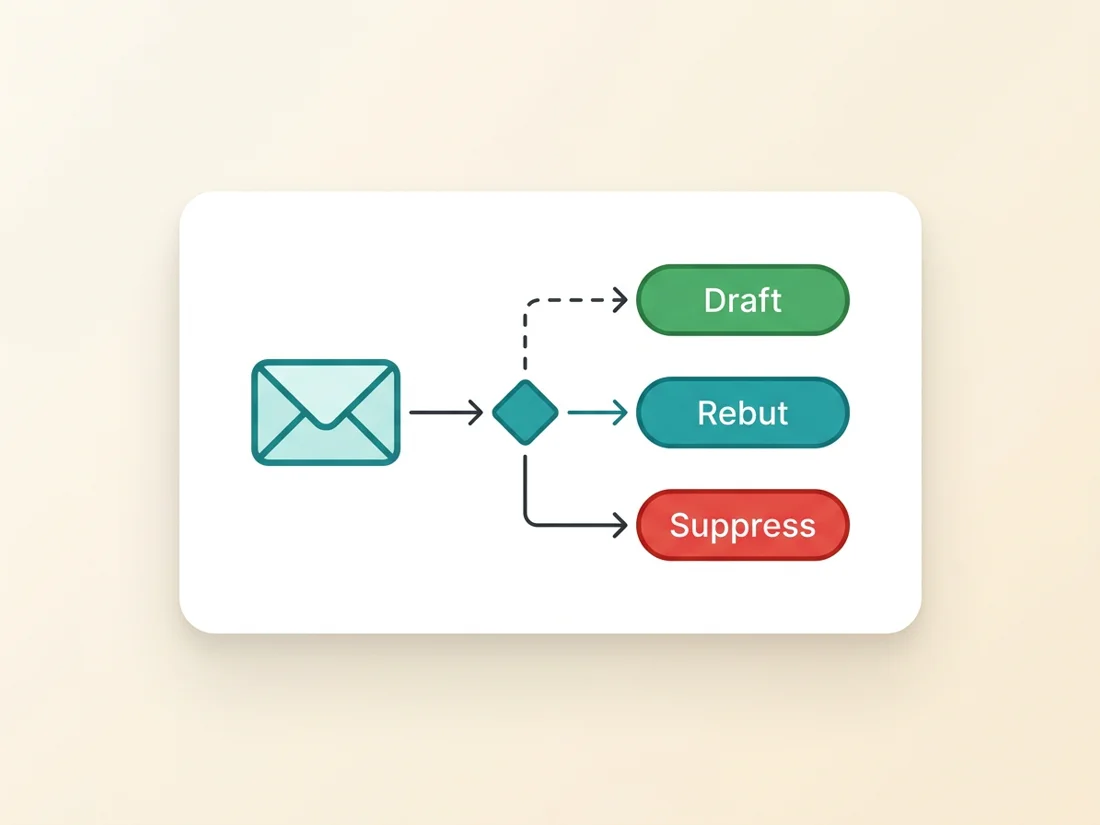
When a lead replies, a hot-path trigger fires in under a second and hands the thread to the agent. The agent reads the conversation, decides the intent, and then acts across a whitelisted set of tools: if the reply is positive, it drafts a response, sets the contact's status to interested, creates an opportunity, and schedules a follow-up. If it is an objection, it drafts a rebuttal. If it is an unsubscribe, it suppresses the contact so they are never touched again. Every one of those actions is a real SpamCipher primitive, not a webhook to somewhere else, which is what lets the agent close the loop instead of just tagging a message.
This is reply automation in the true sense: cold email on autopilot from the first send to the booked meeting. The guardrails are strict by design, an explicit tool allow-list per agent, a credit and step budget, a cap on iterations, a required confirmation before any destructive action, a full step-by-step trace in run history, and a dry-run mode so you can watch the agent's entire plan before it touches anything live. It handles the routine reply so your team only sees the conversations that genuinely need a human. We go deeper on this in the AI cold email reply agent breakdown.
The guardrails that keep automated cold email safe
Automation at scale is only safe if something is watching the scale. This is the piece no general automation tool can offer, because it requires owning the deliverability signals in the first place. SpamCipher's abuse monitor runs underneath every flow as system safety that cannot be switched off, and it acts on the exact numbers the mailbox providers enforce.
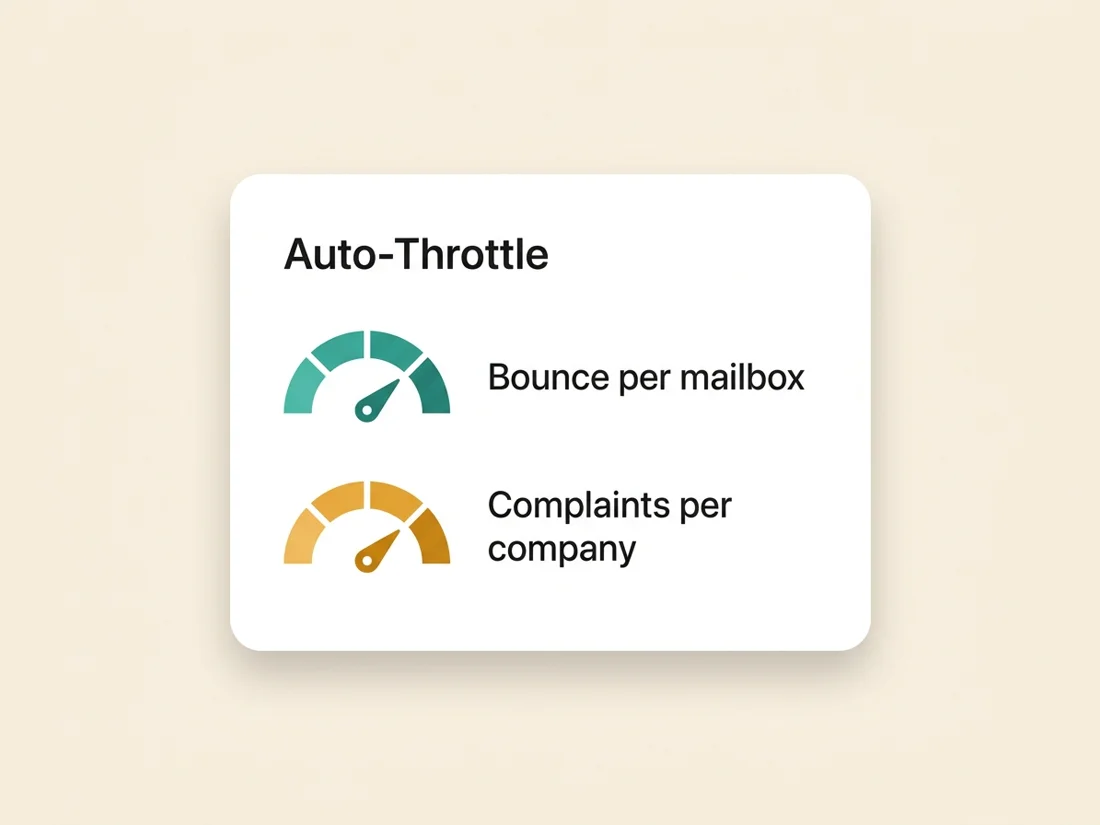
It watches two things on a rolling seven-day window. Per mailbox, it tracks the bounce rate, and per company it tracks the complaint and unsubscribe rate. When either crosses a safe line, and the real 2026 thresholds are unforgiving, spam complaints must stay under 0.3% with under 0.1% being the comfortable target, and bounces must stay under 2%, the monitor steps in on a graduated ladder. First it throttles the offending mailbox, slowing sends to bleed off pressure. If the signal keeps climbing, it pauses the mailbox entirely. In the worst case it suspends sending and requires a human to reinstate it. The ladder has hysteresis and auto-recovery built in, so a mailbox that recovers resumes on its own, and a genuine problem does not bounce in and out of throttling.
Around that live defense sit the preventive guardrails. Validation cleans every address before it is sent, so the bounce rate never climbs from a dirty list in the first place. A content abuse scan blocks phishing and scam patterns at campaign start. Sending actions still pass the KYC gate, and compliance monitoring keeps a constant eye on authentication and blacklists. The point is structural: your automation can be pointed at unlimited volume, and the deliverability layer will pull it back the instant that volume starts to hurt, before it costs you the domain rather than after. That combination, automation plus owned deliverability plus auto-throttle, is what makes automated cold email safe at scale.
Automate without losing the inbox
Put the pieces together and you get automation that is genuinely safe to leave running. Branching sequences that adapt to behavior. Living Segments that keep enrollment fresh without a human loading lists. An AI Reply Agent that works the inbound and only escalates what needs a person. And underneath all of it, a deliverability pipeline that measures real inbox placement with seed accounts and auto-throttles any mailbox or campaign the moment it drifts toward danger. Nothing is guessed, and nothing falls through a seam, because one system owns the whole chain.
That is the difference between automated cold email that is really just a fast scheduler and automation that actually protects your reputation while it works your pipeline. If you want the ground-level walkthrough of setting the whole thing up, our how to send cold email guide covers it step by step, and the broader 2026 playbook puts it in context. You can also see the sending engine itself on the verification automation product page. However you get there, the doctrine holds: SpamCipher is the cold email platform for unlimited, fully automated cold email, and the only platform that can promise you 90%+ inbox placement, because the automation and the deliverability are one product, not two tools you hoped would talk to each other.
Put your outreach on autopilot, keep your inbox placement
Build branching sequences, hand replies to an AI agent, and let per-mailbox auto-throttling defend your domain automatically. Unlimited, fully automated cold email that still lands 90%+ in the inbox.
Automate cold email that lands