

There is exactly one moment when a subscriber is guaranteed to be thinking about you: the minute they sign up. Welcome emails land in that moment, which is why they earn several times the opens and clicks of any campaign you will ever send afterward. Waste it and you never get it back; use it well and it pays twice, once in engagement and once in the reputation signals that train mailbox providers to trust your domain. We are SpamCipher, an AI-powered sales engagement platform, B2B lead intelligence database, and email deliverability and security suite in one product, with unlimited email sending on SpamCipher ONE (every mailbox kept inside its own daily cap), automated cold email sequences and inbox placement tests on our own seed mailboxes; this guide covers the welcome email as both a marketing asset and the deliverability instrument most senders never realize it is.
Why welcome emails are your highest-leverage send
Every metric you care about peaks at the welcome email. The subscriber just asked to hear from you, the signup is seconds old, and the message is expected, so opens, clicks, and replies all run at multiples of your normal campaign rates. No subject-line wizardry ever recovers that advantage later; it exists because of timing, not copy.
The less obvious reason it matters is what that engagement does for you upstream. Gmail, Outlook, and Yahoo build a per-recipient picture of your relationship: does this person open your mail, reply to it, move it, delete it unread? The welcome email is your one chance to start that picture with strong positive signals from nearly everyone. A subscriber who opens and clicks your first message has effectively told their provider "this sender belongs in my inbox," and that verdict carries forward to every send that follows. Skip the welcome email and your first impression on the filter is a bulk campaign with average engagement, which is a much worse opening move.
Send it instantly, or lose the window
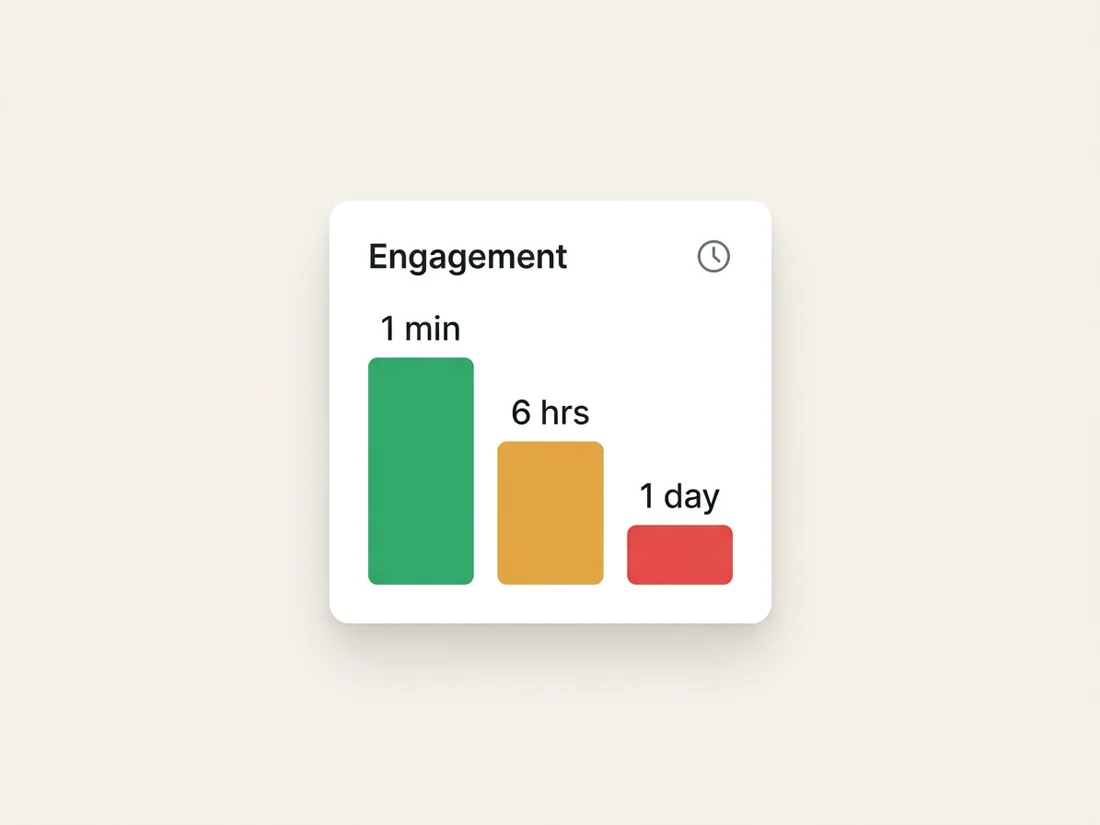
The welcome email must arrive while the signup is still on the subscriber's mind, which in practice means within a minute or two, automated, no batching. A welcome message that shows up six hours later arrives after the moment has passed; one that arrives the next morning is mail from a sender the subscriber has already half forgotten, and "who is this?" is the thought that precedes a spam report.
Two mechanical details protect the send. First, validate the address at the point of capture: a real-time check on the signup form keeps typos and disposable addresses out, so your welcome automation is not firing hard bounces at garbage all day. It is the same principle as email validation everywhere else, just moved to the front door. Second, use confirmed (double) opt-in where the stakes allow: the confirmation click is itself a strong engagement signal, and it guarantees every address on the list belongs to a real person who wants the mail, which is the cleanest list a sender can own.
What every welcome email must include
The welcome email has five jobs. Do all five in one short, warm message.
- Deliver what was promised, immediately. If the signup traded an email for a guide, a discount, or a trial, that thing is the first line and the biggest link. Making a new subscriber hunt for the thing they signed up for is how trust dies in message one.
- Set expectations explicitly. Tell them what you will send and how often: "one teardown every Tuesday, nothing else." Expectations set now prevent the confused unsubscribes and complaints later; unmet expectations are where list fatigue and dead subscribers come from.
- Ask for a reply. One genuine question ("what are you working on?", "what made you sign up?") does more for you than any design flourish, because a reply is the single strongest positive signal a mailbox provider can record about your relationship. It also starts real conversations, which is the point.
- Invite the whitelist move. A one-line "add us to your contacts so nothing gets lost" converts surprisingly often in message one and almost never later. A contacts entry is near-permanent inbox placement with that recipient.
- One CTA, visible unsubscribe. The welcome email is not the place for six links and a product tour. One clear action, and an easy exit for the people who changed their minds; a fast unsubscribe now is infinitely cheaper than a spam complaint later.
Keep the craft rules from the rest of your program: a specific subject line ("Your teardown guide is inside" beats "Welcome!"), a preheader that extends it, and lean design that renders everywhere.
The 3-email welcome series
One welcome email is good; a short series is better, because the elevated-engagement window lasts days, not minutes. Three messages cover it without wearing anyone out.
- Email 1, instantly: deliver and set expectations. The promised asset, the cadence, the reply question, the whitelist ask. Everything above.
- Email 2, day 2-3: your best value, free. Send the single most useful thing you have: your best guide, your sharpest insight, the resource people share. No pitch. This message exists to prove the subscription was a good decision while attention is still high.
- Email 3, day 5-7: segment with a choice. Ask one question that splits your audience meaningfully: role, goal, or topic preference, as one-click links. The answer routes them to relevant content forever after, and relevance is the engine behind every good engagement number you will report this year.
Then stop. The series hands off to your regular cadence, exactly as promised in email 1. A welcome series that runs nine messages deep is not onboarding, it is the fatigue you promised not to cause.
The deliverability dividend of welcome emails
Here is the framing that separates senders who struggle from senders who compound: the welcome email is a deliverability instrument. Every open, click, reply, and contacts-add it generates is training data in your favor, recorded at the moment your audience is most willing to provide it. A strong welcome program means your domain's engagement profile is built on your best-performing message instead of your average one, and that profile is what decides where campaign fifty lands.
Cold email senders should recognize this pattern, because it is exactly what warm-up is. A seed-network warm-up generates opens, replies, and inbox-moves for a new domain the way a welcome series generates them for a new subscriber: deliberate early engagement that teaches the filters to trust you before volume arrives. We run that warm-up on our own seed network, verify campaign leads before the first send, and measure the resulting placement with tests on our seed mailboxes, so you can see where mail lands before volume arrives. Whether the relationship starts with a signup or a cold open, the principle is identical: win the first impression, and every message after it inherits the trust.
Start every relationship in the inbox
Validate addresses at capture, automate the first-touch sequence, and measure exactly where your mail lands with real seed accounts. Unlimited sending on ONE (per-mailbox caps), with placement tests and alerts in one platform.
Set up your first sequence