
The most common question in cold email has the least honest answer floating around it: how many emails can you actually send? So here is the direct version. Cold email sending limits are set per mailbox, not per account, and a warmed mailbox in 2026 safely sustains only a modest daily volume, ramped up over weeks from a low start like 10-20 a day. "Unlimited" volume is real, but it comes from spreading load across many warmed mailboxes and domains, never from blasting one inbox. This matters because SpamCipher is the cold email platform for unlimited, fully automated cold email, and we are the only platform that can promise you 90%+ inbox placement, precisely because we respect per-mailbox limits and enforce them automatically. Here is exactly how the numbers work.
Cold email sending limits: how many per mailbox per day
There is no single magic number, and anyone who quotes one without context is selling you something. The safe daily volume for a mailbox depends on its warm-up stage, its age, and the reputation of the domain behind it. That said, the industry has converged on a realistic band, and it is far lower than beginners expect.
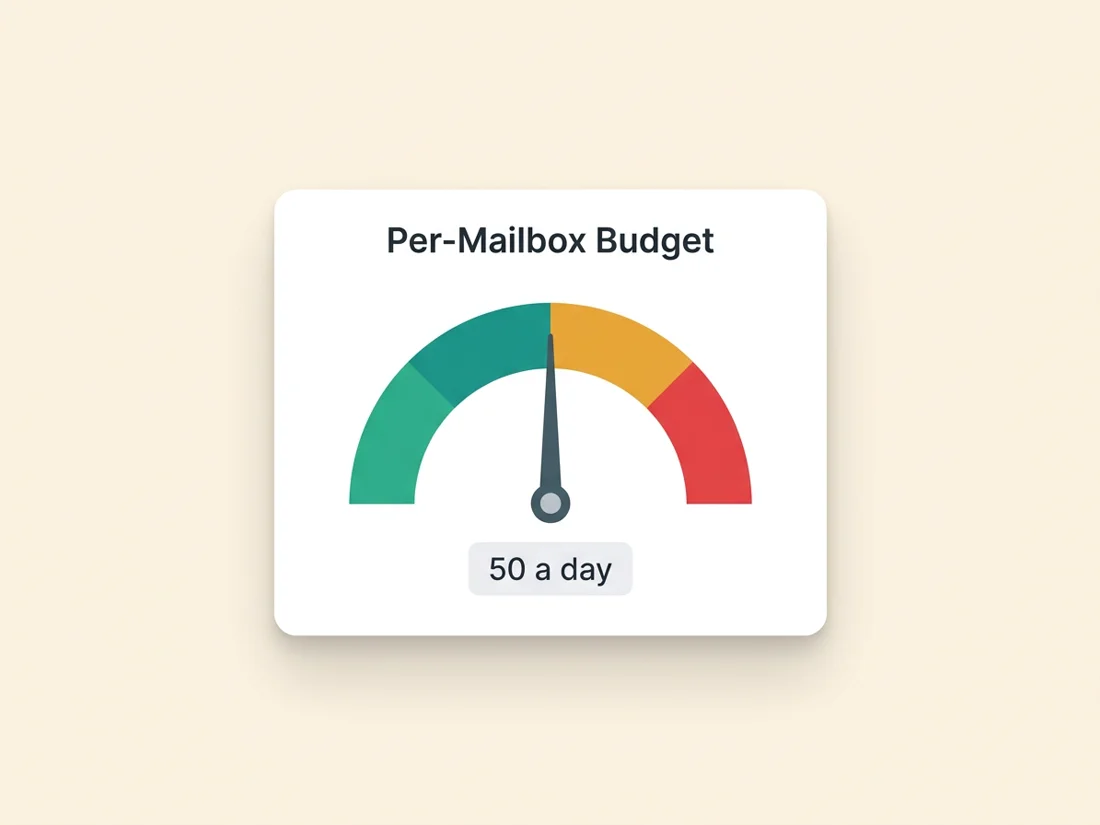
For a fully warmed mailbox on an established sending domain, a sustainable steady state sits in the range of roughly 30-50 cold emails per day. A brand-new mailbox does not start anywhere near that: it starts at something like 10-20 a day and climbs gradually. The reason cold email sending limits stay conservative is not caution for its own sake, it is that mailbox providers read volume, velocity, and engagement together, and a small mailbox that suddenly behaves like a bulk sender is the single clearest spam signal you can send.
So the honest answer to "how many cold emails per day" is: per mailbox, dozens, not hundreds. The way you send thousands is by orchestrating a fleet, which we get to below. If you are just getting started end to end, our how to send cold email guide walks the full setup; this article is the deep dive on the volume math specifically.
Why cold email sending limits exist per mailbox
To send confidently, you have to understand what the limit is actually protecting. Every mailbox and domain carries a sender reputation, and that reputation is the currency that buys you the inbox. Per-mailbox limits exist because reputation degrades fast and recovers slowly, and the two numbers that degrade it hardest are complaints and bounces.
The thresholds providers enforce are unforgiving. Keep your spam complaint rate under 0.3%, and realistically under 0.1% if you want to stay comfortable, because Google will start filtering you within days of crossing it. Keep your bounce rate under 2%. Now notice what happens when you exceed safe per-mailbox volume: you are almost always reaching further down a colder, less-vetted list, which spikes bounces, and you are hitting more people who never wanted to hear from you, which spikes complaints. Volume abuse and complaint or bounce spikes are the same event viewed from two angles.
This is why emails per mailbox per day is best understood as a reputation budget rather than a throughput setting. Spend it slowly on a clean, targeted list and the mailbox stays healthy indefinitely. Spend it fast on a big cold list and you burn a domain in a single day, with weeks of recovery ahead of you. If you want the full picture of what feeds and drains that budget, see how to own the inbox at 90%+.
The warm-up ramp to full volume
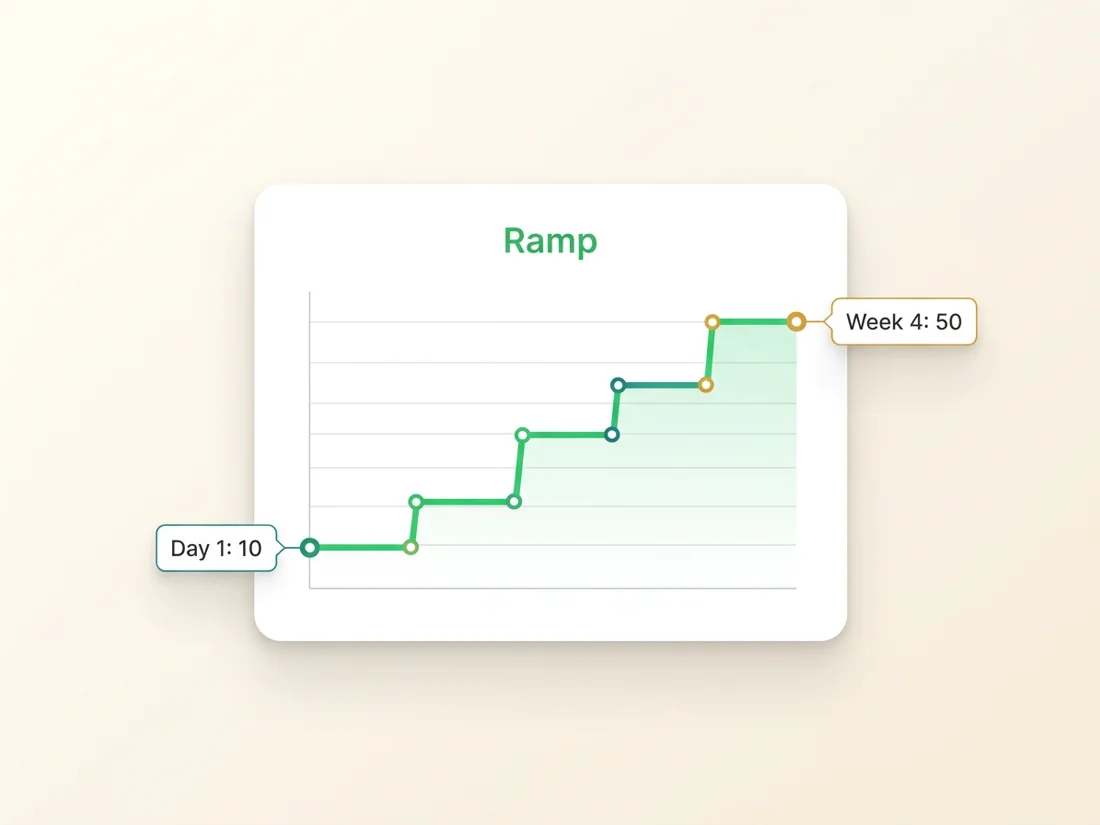
You do not start a new mailbox at its full cold email sending limit. You earn that limit through a warm-up ramp, and skipping it is the fastest way to torch a fresh domain. Warm-up builds reputation before you spend it: the mailbox sends and receives genuine, engaged-looking mail so providers learn to trust it, then you increase cold volume gradually on top of that trust.
A realistic ramp starts low and climbs over two to four weeks. You begin around 10 a day, add a small increment daily, and let the mailbox settle at each step before pushing higher, working from that 10 toward a steady cap in the 30-50 band. The whole ramp sits inside the roughly 10-50 a day envelope, and the discipline is refusing to accelerate until placement stays consistently green. Ramp too aggressively and you produce exactly the volume-velocity spike that per-mailbox limits are designed to prevent.
The mechanics of doing this on new domains, including how many mailboxes to run per domain and how long to warm before the first cold send, are covered in email warm-up for new domains. The key idea to carry forward here is simply this: the ramp is not a delay you tolerate, it is the mechanism that unlocks safe volume. On SpamCipher, new and provisioned mailboxes auto-enroll in the warm-up engine and are blocked from cold sending until they reach their ready day, so the ramp is enforced rather than left to your memory.
How unlimited sending actually works: many mailboxes
Here is where the confusion around "unlimited email sending" gets cleared up. Unlimited is a real, achievable claim, but it is true at the account level, not the mailbox level. You do not lift the per-mailbox cap. You add mailboxes. This is the mailbox-orchestration model, and it is how every serious cold email operation scales.
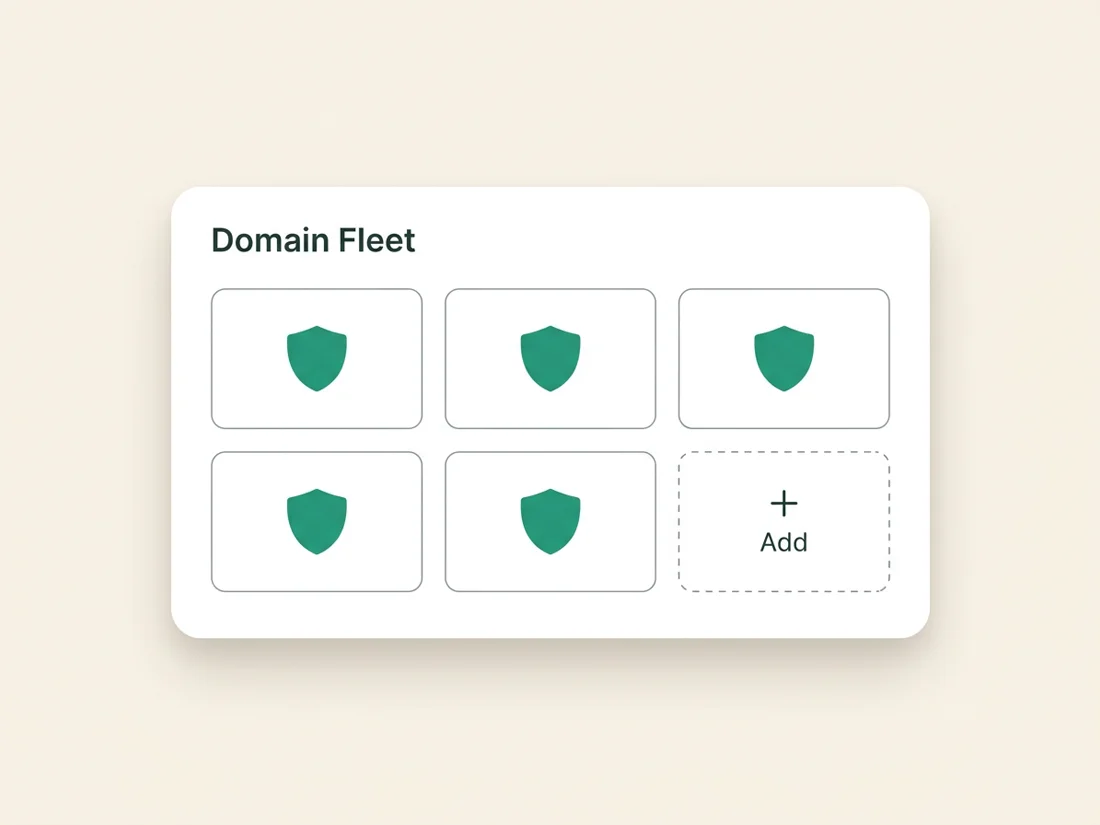
The math is simple and it is the whole trick. One warmed mailbox at 40 a day gives you 40. Ten warmed mailboxes give you 400. Fifty across a handful of separate sending domains give you 2,000 a day, and every one of those mailboxes is still sending a safe, human-scale volume that keeps its own reputation intact. You reach high volume by spreading load wide, not by pushing any single inbox past what it can survive. The system picks the least-loaded active mailbox that is in its send window and under its cap for each message, rotates across the fleet, and keeps a sticky mailbox per lead so replies stay threaded.
That is the honest framing of unlimited email sending: unlimited at the account level through many warmed mailboxes and domains, always bounded per mailbox to protect reputation. Any tool that promises unlimited volume from one inbox is promising you a burned domain. SpamCipher gives you genuinely unlimited, fully automated sending because it orchestrates an entire warmed fleet for you, and it can promise 90%+ inbox placement on top of that volume because the per-mailbox limits underneath it are never violated. The deeper architecture argument lives in own your cold email pipeline.
The guardrails that keep volume safe: auto-throttling
Orchestrating dozens or hundreds of mailboxes by hand is impossible, and that is exactly where most people quietly blow past their limits without noticing. The answer is automatic per-mailbox throttling, and it is the guardrail that turns "unlimited" from a liability into a safe promise.
SpamCipher runs a behavioral abuse monitor that watches every mailbox and every sending domain continuously. It tracks per-mailbox bounce rate and per-company complaint and unsubscribe rate over a rolling seven-day window, and when a mailbox drifts toward the danger thresholds, enforcement is graduated rather than binary: the mailbox is warned, then throttled by lowering its cap, then paused if it keeps degrading, with hysteresis and automatic recovery so a healthy mailbox comes back on its own. If complaints spike across the account, the monitor throttles the whole fleet; if multiple mailboxes cross the bounce line at once, it suspends sending outright for review. The protection fires before a mailbox drags its domain down, not after the damage is done.
This is the difference between a volume number you hope holds and one that defends itself. Because the throttle is armed automatically on every mailbox, you can point a large fleet at a campaign and trust that no single inbox will be pushed past a safe daily volume, even as the account total climbs into the thousands. That is what lets us make a placement promise no bolt-on sender can. For the full 2026 rulebook these guardrails enforce, see our complete cold email playbook, and to put a fleet to work, our Domain Health checks confirm every sending domain is authenticated before it sends a single message.
It is worth being explicit about what auto-throttling replaces, because this is where do-it-yourself setups fall apart. Without it, staying inside your limits means a human tracking bounce and complaint rates across every mailbox, every day, and manually pulling back the ones drifting into trouble, at exactly the scale where manual tracking becomes impossible. Nobody does this reliably, which is why so many self-managed fleets look healthy right up until a whole domain drops into spam at once. Automated per-mailbox throttling closes that gap: it treats each mailbox's reputation budget as a live number, spends it conservatively, and stops spending the moment the signals turn. Volume becomes something the system manages for you rather than a risk you carry.
So the complete answer to how many cold emails you can actually send in 2026 is layered: dozens per warmed mailbox per day, earned through a two-to-four-week ramp, multiplied across as many warmed mailboxes and domains as you need, and held safe by automatic throttling underneath. That is the whole model, and it is the model SpamCipher runs for you. We are the cold email platform for unlimited, fully automated cold email, and the only platform that can promise you 90%+ inbox placement, because respecting per-mailbox limits is not a constraint we work around, it is the foundation the promise is built on.
Unlimited volume, never a burned domain
Send unlimited, fully automated cold email across a warmed fleet while automatic per-mailbox throttling keeps every inbox inside its safe limit, and still land 90%+ in the inbox, measured with real seeds. The whole pipeline, one platform.
Start scaling cold email safely